Trompe l’oeil hoarding effectively mimics the building’s façade to hide the construction site and scaffolding.

When refurbishment or construction work takes place around an important building, standard site hoarding can sometimes feel completely out of place. This is particularly true in London, where historic architecture, listed buildings and high-profile public spaces need to remain presentable even while essential work is underway.
That is where Trompe l’oeil hoarding can make a significant difference.
Project Print Management (PPM) specialises in large format graphics, building wraps and printed hoardings designed to disguise construction activity and reproduce the appearance of the architecture behind them. By carefully recreating façades, windows, stonework and other architectural features, temporary construction areas can become far less intrusive.
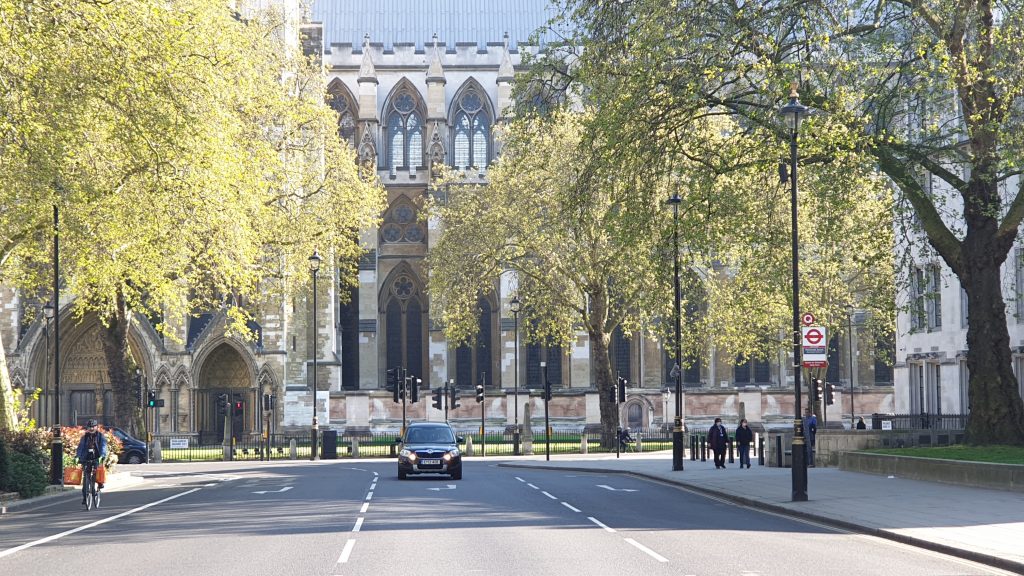
One of PPM’s most memorable examples was the Trompe l’oeil hoarding installed at Westminster Abbey in London.
Trompe l’oeil Hoarding at Westminster Abbey
Westminster Abbey is one of the UK’s most recognisable historic buildings and welcomes visitors from around the world every year.
Any temporary construction works around a building of this importance need to be handled sensitively. Simply installing blank construction panels would have created a strong visual contrast with the surrounding architecture.
PPM’s solution was to create a Trompe l’oeil hoarding that reproduced elements of the Abbey’s façade and helped the construction area blend more naturally into its surroundings.
The completed installation measured approximately 4 metres high and 87 metres long, creating a substantial printed façade around the works.
The imagery was digitally printed onto aluminium composite panels, creating a durable, rigid surface capable of producing the detail and colour needed for architectural reproduction.
Rather than filling the installation with advertising messages or unnecessary text, the design was deliberately kept simple.
With Westminster Abbey attracting international tourists, school groups and visitors of many nationalities, the visual treatment needed to communicate without relying heavily on written messaging.
The architecture itself became the design.
How Realistic Trompe l’oeil Hoarding Is Created
Producing convincing architectural graphics involves considerably more than enlarging a photograph.
PPM’s process starts with understanding the building and the area that needs to be concealed.
Accurate site measurements are essential. Photography also needs to be taken from appropriate positions so the artwork can be developed with the correct proportions and perspective.
The images are then carefully prepared by designers to create the most realistic result possible.
Colour, scale, architectural details and perspective all need attention.
If a window, column, decorative feature or section of stonework is incorrectly positioned, it can quickly destroy the illusion.
This becomes particularly important on a Trompe l’oeil hoarding stretching tens of metres along a highly visible pedestrian location.
When completed successfully, however, the effect can be impressive.
The temporary structure no longer dominates the view. Instead, the printed surface helps continue the architectural character of the building while essential construction or restoration work takes place behind it.
Why Use Trompe l’oeil Hoarding?
Construction sites are necessary, but they are rarely attractive.
Scaffolding, temporary fencing, building materials and site compounds can significantly change the appearance of a location for months or sometimes years.
For historic buildings, hotels, retail developments, public spaces and prestigious commercial properties, maintaining appearances during refurbishment can be especially important.
Trompe l’oeil hoarding provides a way of screening the construction area while creating something much more visually sympathetic.
It can be used to reproduce the original building, show how a development will eventually look, create decorative architectural graphics or combine realistic imagery with carefully positioned branding and information.
In busy parts of London, where thousands of people may walk past a construction site every day, that improvement can be considerable.
Rather than presenting the public with plain hoarding or an exposed building site, printed architectural graphics can help the temporary installation become part of the surrounding streetscape.
Large Format Printing for Historic Buildings
PPM has worked on a number of challenging projects involving architecturally important buildings and high-profile locations.
These have included projects at Westminster Abbey, Somerset House, Fulham Palace and properties around Harley Street, where the quality of the finished installation is particularly important.
In these environments, there is rarely a standard solution.
Every building is different.
The shape of the façade, location of the scaffolding, viewing distance, installation method and duration of the construction programme can all affect how the graphics need to be produced.
Materials also have to be selected carefully.
For rigid printed hoarding, aluminium composite panels can provide an excellent smooth printing surface and professional finish.
For scaffold wraps and much larger elevations, mesh PVC is often more appropriate because it allows a degree of airflow through the material.
Large Format Building Wraps at Somerset House
The same principles used for architectural hoarding can also be applied to much larger scaffold wraps.
At Somerset House in London, PPM produced large format graphics designed to improve the appearance of refurbishment works at this prestigious location.
The building is well known not only for its architecture but also for the events hosted within its courtyard, including winter ice skating and outdoor film screenings during the summer.
Maintaining the appearance of a venue like this while work takes place can therefore be particularly important.
For this project, the building wrap was digitally printed using UV ink technology onto Verseidag mesh PVC banner material.
The mesh structure allows air to pass through the print, which is an important consideration when installing very large graphics onto scaffold structures.
It demonstrates how the material and installation method must always be considered alongside the creative design.
A beautiful graphic is only successful if it can also be manufactured and installed correctly.
More Than Just Printing
This is an important part of PPM’s approach.
Large format printing is only one stage of delivering a successful project.
Before anything reaches the printer, consideration needs to be given to surveying, artwork, materials, structures, access and installation.
On particularly challenging projects, PPM works alongside designers, scaffold contractors, construction companies and specialist installation teams to develop a practical solution.
That experience is especially valuable when working on unusual structures where a similar project may never have been attempted before.
PPM has delivered projects ranging from enormous stadium graphics and building wraps to specialist internal protection screens and bespoke wrapped structures.
Recent examples include the Everton FC stadium wrap, the BNP Paribas lift shaft printed protection screen and the Kingston Market stall door wraps.
All three are very different projects, but they share one thing in common: each required far more than simply supplying printed material.
Combining Traditional Architecture with Modern Print Technology
One of the most interesting aspects of Trompe l’oeil hoarding is the contrast between traditional architecture and modern digital printing technology.
Buildings such as Westminster Abbey have stood for centuries.
Yet sophisticated photography, digital artwork and large format printing can now be used to temporarily recreate parts of their appearance while conservation or construction work takes place behind the scenes.
Used correctly, the technology doesn’t compete with the building.
It helps protect the visual character of the location during a temporary period of disruption.
That is why Trompe l’oeil graphics have become such an effective option for historic properties, luxury developments and prominent construction sites throughout London and the wider UK.
Practical Solutions for Challenging Large Format Print Projects
At Project Print Management, we enjoy projects where the answer isn’t immediately obvious.
Whether the requirement is a Trompe l’oeil hoarding, a full scaffold wrap, a building façade reproduction or a completely bespoke printed solution, the starting point is always the same: understand what the client is trying to achieve and then work out the most practical way to deliver it.
The Westminster Abbey installation remains a perfect example.
A major construction area needed to be concealed at one of London’s most important historic landmarks.
The solution was not to hide the site behind a blank wall, but to use large format printing to help the temporary structure blend with the architecture surrounding it.
The result demonstrates what can be achieved when careful surveying, design, printing and installation all work together.
For PPM, that is what makes challenging large format print projects so rewarding.
When the print becomes part of the architecture rather than simply covering it, Trompe l’oeil hoarding can completely transform the appearance of a construction site.
For more information about Project Print Management and Trompe l’oeil hoarding visit www.projectprintmanagement.co.uk/trompe-loeil-print/