Cheap Scaffold Wrap: Can You Do It Cheaper? What’s The Real Cost….
“Can You Do It Cheaper?”
It is, probably one of the most common questions we are asked at Project Print Management:
“Can you do it cheaper?”
The simple answer is yes.
Almost any large-format print project can be made cheaper. We can reduce the time spent preparing the artwork, use a lower-cost print specification, simplify the installation, reduce the supporting framework or choose a more basic finishing method.
But there is another question that should be asked at the same time:
“What will it look like if we do it cheaper?”
When you are talking about a small temporary sign, the difference may not be particularly important. When you are covering several storeys of a prestigious building in central London, however, the difference can be enormous.
The Grosvenor Hotel on Park Lane provides an excellent example.
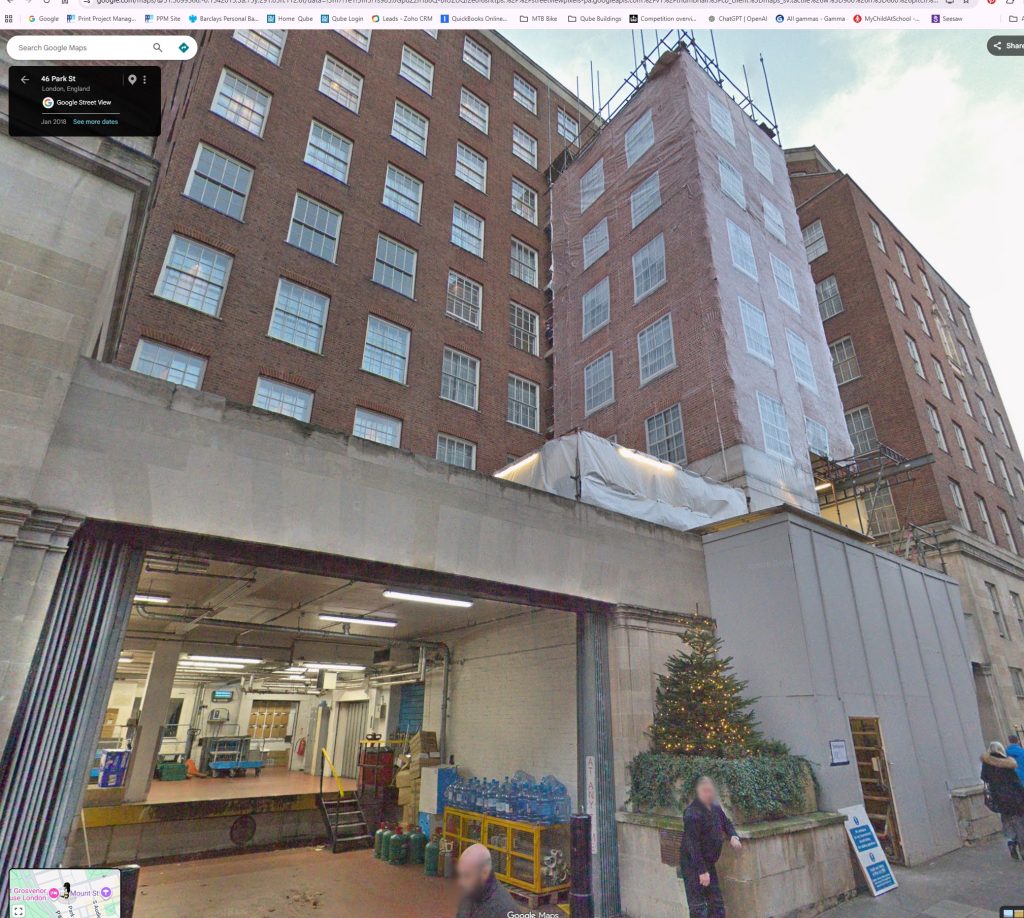
A Cheap Scaffold Wrap Still Covers the Scaffolding – But Is That Enough?
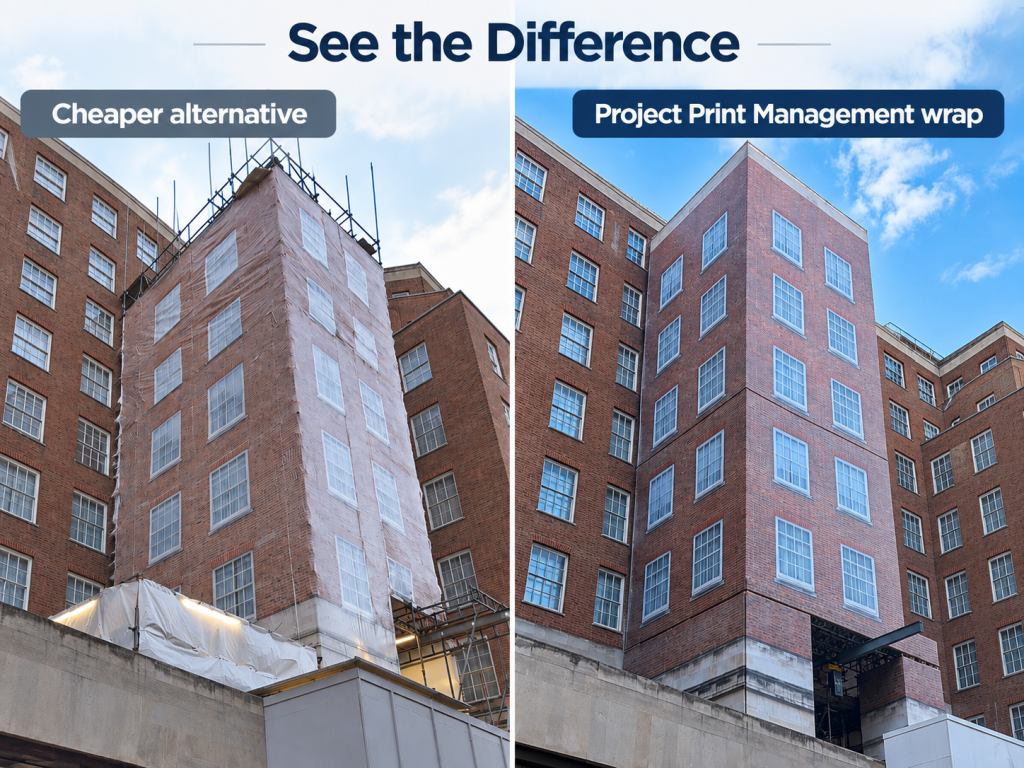
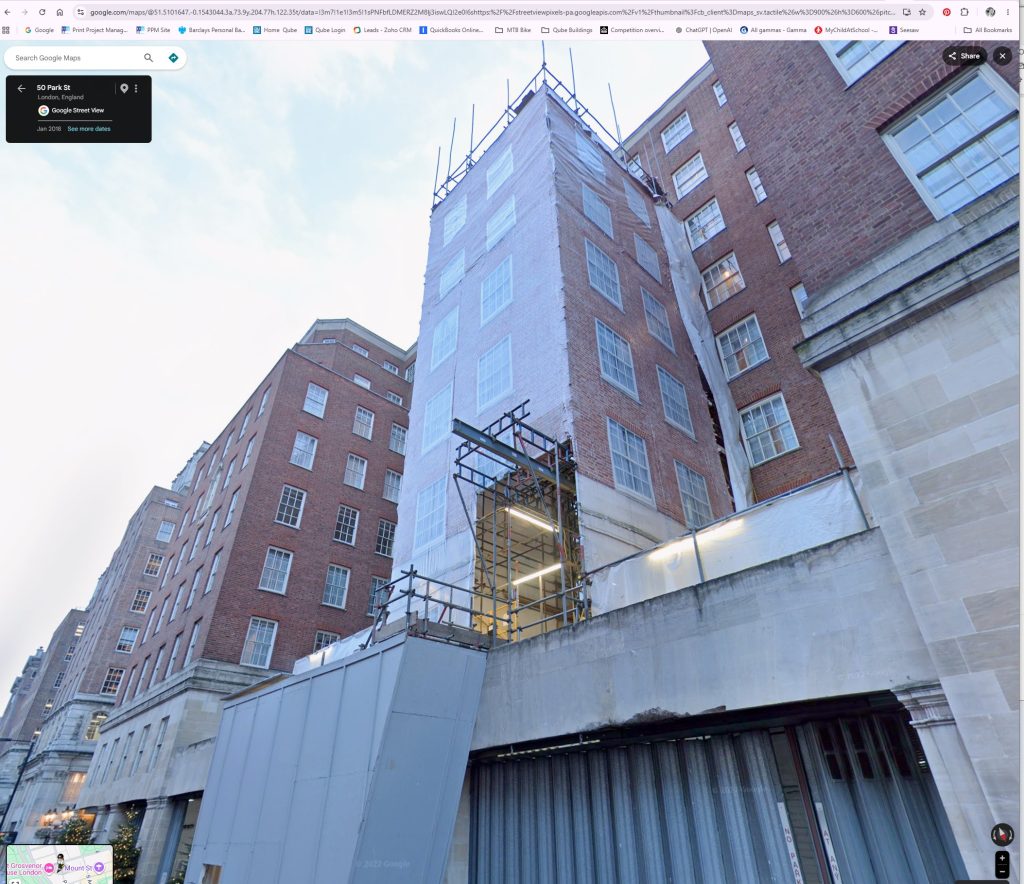
The photographs above show an earlier scaffold wrap installed at the hotel before Project Print Management became involved.
Technically, it did its job.
The scaffold structure was covered and an image of the building façade had been printed onto the material.
However, visually, it is immediately obvious that it is a printed sheet covering scaffolding.
The colours appear considerably lighter than the surrounding building, the brickwork lacks depth and definition, and the windows do not convincingly reproduce the appearance of the actual hotel.
From a distance, rather than blending into the existing architecture, the scaffold wrap stands out from it.
And that is the fundamental difference between simply printing a picture of a building and creating a convincing trompe l’oeil scaffold wrap.
Both approaches use printed material.
The finished results can be completely different.
Compare That With Our Grosvenor Hotel Scaffold Wrap
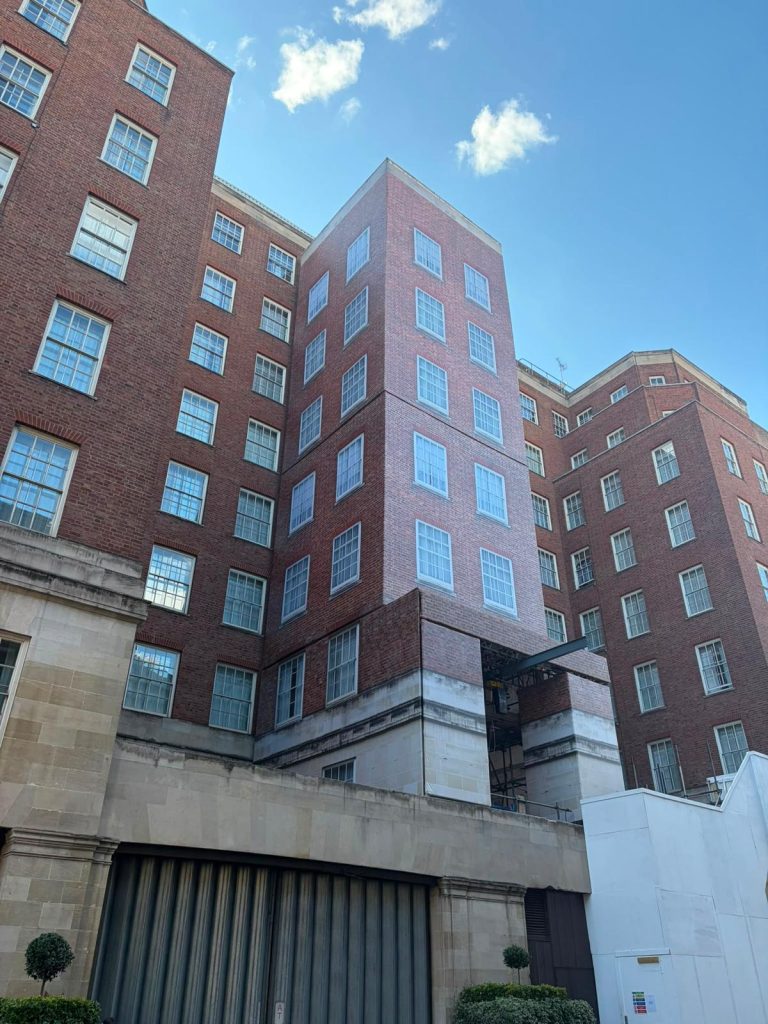
When Project Print Management was later asked to produce a scaffold wrap at the Grosvenor Hotel, the objective wasn’t simply to hide the scaffolding.
The hotel remained operational throughout the works, so appearance was extremely important.
Park Lane is one of London’s most prestigious locations. Thousands of guests, pedestrians and motorists pass the hotel, meaning that a poorly reproduced façade would be highly visible.
Our objective was therefore to make the temporary printed façade blend as naturally as possible with the real building around it.
Look at the photographs of our finished installation and compare them with the earlier wrap.
The difference is not simply the printing.
It is the entire process.
The brick colour has been carefully matched to the surrounding elevations. Windows have the correct proportions and architectural appearance. Perspective, scale, contrast and colour have all been considered so that the printed elevation reads as part of the building rather than as an advertisement or temporary covering.
From normal viewing distances, your eye initially accepts what it sees as architecture.
That is exactly what a good trompe l’oeil building wrap should achieve.
The Client’s Reaction Says It Better Than We Can
Once our scaffold wrap had been installed, we received this comment from the client:
“As for the scaffold wrap, this has been a revelation! The Exec Team can’t believe how realistic it looks.”
For us, that sums up the difference between buying a printed scaffold covering and investing in a professionally managed building wrap.
It isn’t necessarily about using an enormously expensive material.
It is about getting dozens of individual details right.
Where Does the Extra Cost Go?
Clients understandably look at two quotations and wonder why one company may be more expensive than another.
After all, isn’t it just a large printed banner?
Not really.
A high-quality scaffold wrap starts long before anything reaches the printer.
Accurate surveys are important because the artwork has to correspond with the dimensions and proportions of the scaffold structure.
Then comes artwork preparation.
Photographs and architectural references may need perspective correction, colour adjustment, retouching, scaling and repositioning. Brick courses, windows, stonework and other architectural features need to work together convincingly.
Colour matching is particularly important.
A brick-red building printed too orange, too pink or too pale immediately exposes the illusion.
The print also has to be produced at an appropriate resolution and using materials suitable for a large external installation.
Then there is installation.
Tension, positioning, joints, edges and the supporting system all influence the finished appearance. A superbly printed image can still look poor if it isn’t installed properly.
These elements all require time, experience and skilled people.
Remove enough of them and, yes, the project becomes cheaper.
But something has to give.
Cheap Doesn’t Always Mean Better Value
There is an important distinction between price and value.
Imagine saving several thousand pounds on a scaffold wrap covering a luxury hotel, premium retail development or landmark London building.
On the quotation, that saving may initially look attractive.
But if the wrap remains in position for six or twelve months and looks obviously artificial every single day, was it really a saving?
For prestigious properties, the temporary façade becomes part of the appearance of the building.
Hotel guests see it.
Neighbours see it.
Potential purchasers and tenants see it.
Investors see it.
The client’s senior management sees it.
In some locations, hundreds of thousands of people may see it during the construction programme.
The price difference between an average wrap and an exceptional one therefore needs to be considered against the number of people who will view it and the image the client wants to project.
There Is Nothing Wrong With Having a Budget
This doesn’t mean every client needs the most expensive specification possible.
Budgets are part of every construction project, and at Project Print Management we regularly help clients find solutions that reduce costs.
What is important is understanding where savings can sensibly be made and where cutting costs will noticeably affect the finished product.
We would much rather explain the options honestly.
For example:
A client may decide they don’t require an elaborate hidden fixing system.
They may choose a simpler artwork treatment.
The print may only be required for a short programme.
Certain elevations may be far less prominent than others.
Those can all create opportunities to reduce costs intelligently.
The problem comes when a premium visual result is expected from a specification that simply does not provide enough budget to achieve it.
Cheap Scaffold Wrap: You Are Not Just Buying Square Metres of Print
This is perhaps the most important point.
When comparing quotations for a cheap scaffold wrap with a professionally managed trompe l’oeil installation, don’t compare only the price per square metre.
Ask what is actually included.
Consider the surveying, artwork preparation, colour matching, print quality, finishing, installation method, tensioning system, project management and experience behind the job.
Two quotations may both say “printed scaffold wrap”.
That doesn’t mean you are buying the same product.
The photographs from the Grosvenor Hotel demonstrate that perfectly.
Both installations covered scaffolding.
Only one resulted in the hotel’s Executive Team saying:
“We can’t believe how realistic it looks.”
And sometimes, that difference is exactly what you are paying for.
For more information NOT on Cheap Scaffold Wrap but Quality Scaffold wraps please contact us. For our latest print project please visit our blog.