
Large-format scaffold wraps are often used to conceal construction and refurbishment works, but they can also become powerful creative installations in their own right. When carefully designed and professionally produced, building wrap artwork can transform scaffolding into a public canvas that communicates identity, creativity and purpose.
Project Print Management was proud to support a major building wrap artwork installation at Somerset House on the Strand in central London.
Commissioned by the Somerset House Trust, the project invited artists from Somerset House Studios to create original artwork for the scaffolded façade while refurbishment works were taking place.
Rather than simply hiding the scaffolding, the project turned a temporary construction requirement into a large-scale cultural statement.

The Brief: Turning Scaffolding into Building Wrap Artwork
Somerset House is one of London’s most recognisable cultural landmarks. The Grade I listed neoclassical building is home to exhibitions, performances, creative residencies and public events throughout the year.
When refurbishment works required scaffolding along the Strand elevation, Somerset House saw an opportunity to do something more ambitious than installing a standard scaffold covering.
The objective was to create building wrap artwork that would conceal the temporary works while also reflecting the creative community based within Somerset House Studios.
The wrap needed to:
-
Conceal the scaffold structure
-
Maintain the appearance of the historic building during refurbishment
-
Showcase artists working at Somerset House Studios
-
Engage pedestrians, commuters and visitors passing along the Strand
-
Communicate the creative identity of Somerset House
The finished installation transformed a practical scaffold wrap into a highly visible piece of public art.
The Concept Behind the Somerset House Artwork
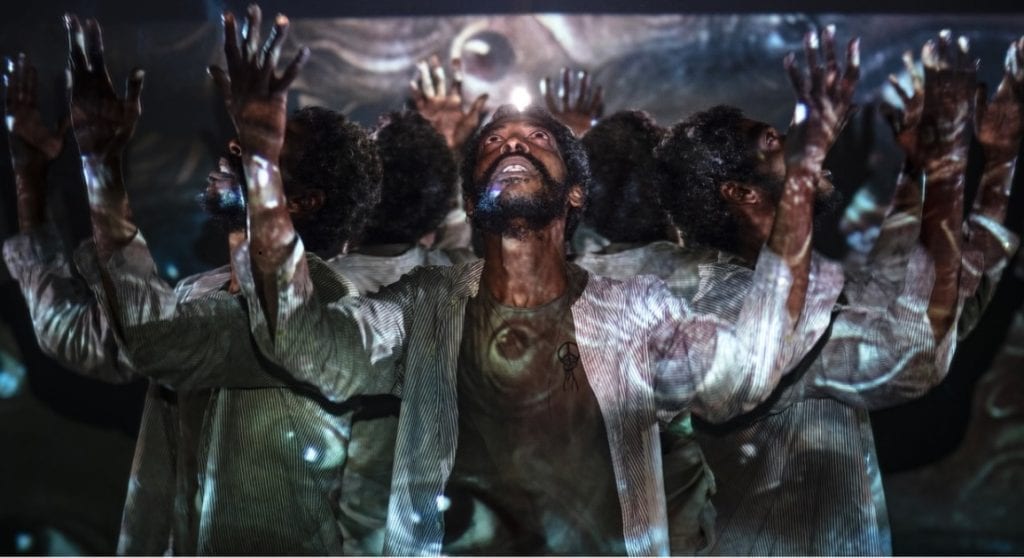
Artists Lain Forsyth and Jane Pollard were commissioned to create new work as part of their ongoing photographic series known as Multi-graphs.
Their work explores portraiture, reflection and visual perception using a technique based around a Victorian mirror device.
The process allows five different views of a subject to be captured simultaneously within a single photographic exposure. Rather than producing the effect through digital manipulation, the image is created in-camera using reflection and refraction.
For the Somerset House building wrap artwork, Forsyth and Pollard photographed fellow artists based at Somerset House Studios.
This meant that the finished scaffold wrap became more than an external decoration. It effectively created a large-scale portrait of the artistic community working inside the building.

Bringing the Creative Community Outside
Somerset House Studios supports artists, filmmakers, musicians, designers and other creative practitioners.
By featuring members of this community on the Strand façade, the building wrap made the activity taking place inside Somerset House visible to the wider public.
This was particularly effective because of the location.
The Strand is one of London’s busiest routes, with large numbers of pedestrians, commuters, tourists and road users passing Somerset House every day.
As a result, the building wrap artwork became part of the surrounding public realm rather than simply a temporary construction covering.
It allowed Somerset House to remain visually active and culturally relevant throughout the refurbishment period.
Preparing Building Wrap Artwork for Large-Format Print
One of the biggest challenges with any building wrap artwork project is translating artwork created at a conventional scale into something capable of covering several storeys of a building.
Images that work perfectly on a computer screen or photographic print must still have the same impact when enlarged across many metres.
Our artwork preparation process considered factors including:
-
Image resolution
-
Cropping and composition
-
Viewing distance
-
Colour accuracy
-
Panel positioning
-
Alignment with architectural features
-
Final installed dimensions
Because the wrap could be viewed both from close range and from across the Strand, the imagery needed to retain detail while still producing a strong overall visual impact.
Scaled proofs and careful artwork preparation helped ensure the photographic work translated successfully onto the façade.
Choosing Mesh PVC for the Scaffold Wrap
Material selection is extremely important when producing large scaffold graphics.
For this building wrap artwork, high-quality mesh PVC was selected.
Mesh PVC is widely used for large external scaffold wraps because the perforated construction allows air to pass through the material. This helps reduce wind pressure compared with solid PVC banner materials.
Other advantages include relatively low weight, durability and excellent print reproduction when viewed from normal building-wrap distances.
On a large installation such as Somerset House, managing wind loading was a particularly important consideration.
The chosen mesh provided the balance required between visual quality and practical performance.
High-Resolution Digital Printing
Artwork featuring large photographic portraits demands excellent print quality.
Even when images are being enlarged to building scale, tonal detail, contrast and colour need to remain consistent.
The Somerset House building wrap artwork was produced using high-resolution large-format digital printing equipment.
Careful colour management helped maintain consistency throughout the individual printed sections, while accurate panel production ensured that the imagery aligned correctly when installed.
Although visitors could approach sections of the wrap relatively closely, the graphics also needed to remain visually effective when viewed from further away.
This combination of near and distant viewing is one of the key considerations when producing artwork for building façades.
Fabrication and Finishing
Once printed, the individual sections required specialist finishing before installation.
High-frequency welding was used to create strong joins between the PVC mesh sections.
This fabrication technique produces clean and durable seams capable of performing in outdoor environments over extended installation periods.
The perimeter of the wrap was also reinforced, with fixing points incorporated to allow the material to be securely attached to the supporting frame.
For installations of this size, finishing quality is just as important as print quality. The artwork must remain properly tensioned and stable if the finished façade is to retain its intended appearance.
Installing the Building Wrap Artwork
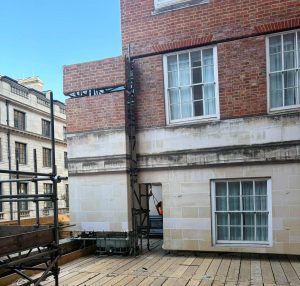
A dedicated sub-frame was installed onto the primary scaffold structure.
This provided a controlled surface onto which the wrap could be tensioned and secured.
Using a correctly designed supporting frame helps produce a cleaner finished appearance while providing appropriate fixing positions around the perimeter and across the surface of the print.
Coordination between the scaffold contractor, main contractor and installation team was essential.
Before installation, the scaffold structure had to be suitable for the additional loads associated with the printed covering.
Safety, access, fixing positions and installation sequencing all formed part of the overall project planning.
The Finished Somerset House Building Wrap
The completed building wrap artwork successfully combined contemporary art with large-format print technology.
Rather than allowing the building to appear hidden behind temporary scaffolding, Somerset House used the refurbishment period to communicate directly with the public.
The wrap:
-
Concealed the scaffold structure
-
Showcased artists working within Somerset House Studios
-
Added visual interest to the Strand
-
Maintained the cultural presence of Somerset House during refurbishment
-
Turned a temporary construction requirement into a creative opportunity
It demonstrated how scaffold wraps can become much more than protective or decorative coverings.
Building Wrap Artwork for Cultural and Heritage Buildings
For cultural institutions, developers and heritage organisations, scaffolding does not necessarily have to interrupt public engagement.
A carefully planned building wrap artwork project can provide an opportunity to tell a story, showcase creativity and enhance the appearance of a site while essential construction works continue behind it.
Project Print Management specialises in the production and installation of large-format building wraps, scaffold wraps and architectural graphics throughout the UK.
From initial artwork preparation and material selection through to printing, fabrication and installation, we help manage the technical requirements needed to turn creative concepts into large-scale finished installations.
The Somerset House project demonstrates what can be achieved when art, architecture and specialist large-format printing come together.
Instead of simply hiding the refurbishment works, the scaffold became a highly visible cultural canvas in the heart of London.
For our latest print projects please visit our blog or for more information on building wraps please visit here.