
Westminster Abbey Printed Hoarding . There’s something quietly remarkable about encountering your own work years later
Especially when it has outlived its intended lifespan. That was exactly the experience when I recently walked past Westminster Abbey and found the printed hoarding we installed back in May 2020 still standing, still doing its job, and—perhaps most surprisingly—still looking exceptionally good.
At the time, the project was born out of necessity. A significant construction initiative required a large section of the Abbey’s exterior to be obscured by scaffolding and protective hoarding. Anyone familiar with heritage sites knows how disruptive this can be visually. When you’re dealing with a structure as architecturally rich and culturally significant as Westminster Abbey, simply covering it up with blank boards would have been a jarring intrusion into one of London’s most historic settings.
The solution was to create a trompe l’oeil print—an illusionist design technique intended to “trick the eye.” Instead of presenting a flat, featureless surface, the hoarding would replicate the Abbey’s own intricate Gothic façade. The idea was not just to hide the works, but to soften their visual impact, allowing passersby to retain a sense of continuity with the building’s original appearance.
Westminster Abbey Printed Hoarding
Back in 2020, achieving this meant an exacting process. High-resolution photography of the Abbey’s exterior was carefully captured, stitched, colour-corrected, and scaled to match the precise dimensions of the hoarding. Every arch, buttress, window detail, and weathered stone tone had to align convincingly. The success of a trompe l’oeil installation depends on accuracy—if proportions are even slightly off, the illusion collapses.
Printing at that scale required equally high standards. We opted for a premium-grade, weather-resistant substrate designed specifically for long-term outdoor use. UV-stable inks were essential, not just to preserve colour vibrancy but to prevent fading under constant exposure to sunlight. London’s climate adds another layer of complexity: rain, pollution, temperature fluctuations, and general urban wear all take their toll on printed materials.
Even with these considerations, the expectation was that the hoarding would last around three to four years at most. That’s generally the upper limit for maintaining visual integrity in an outdoor installation of this type. Beyond that, you typically begin to see noticeable degradation—fading, peeling, staining, or structural wear.
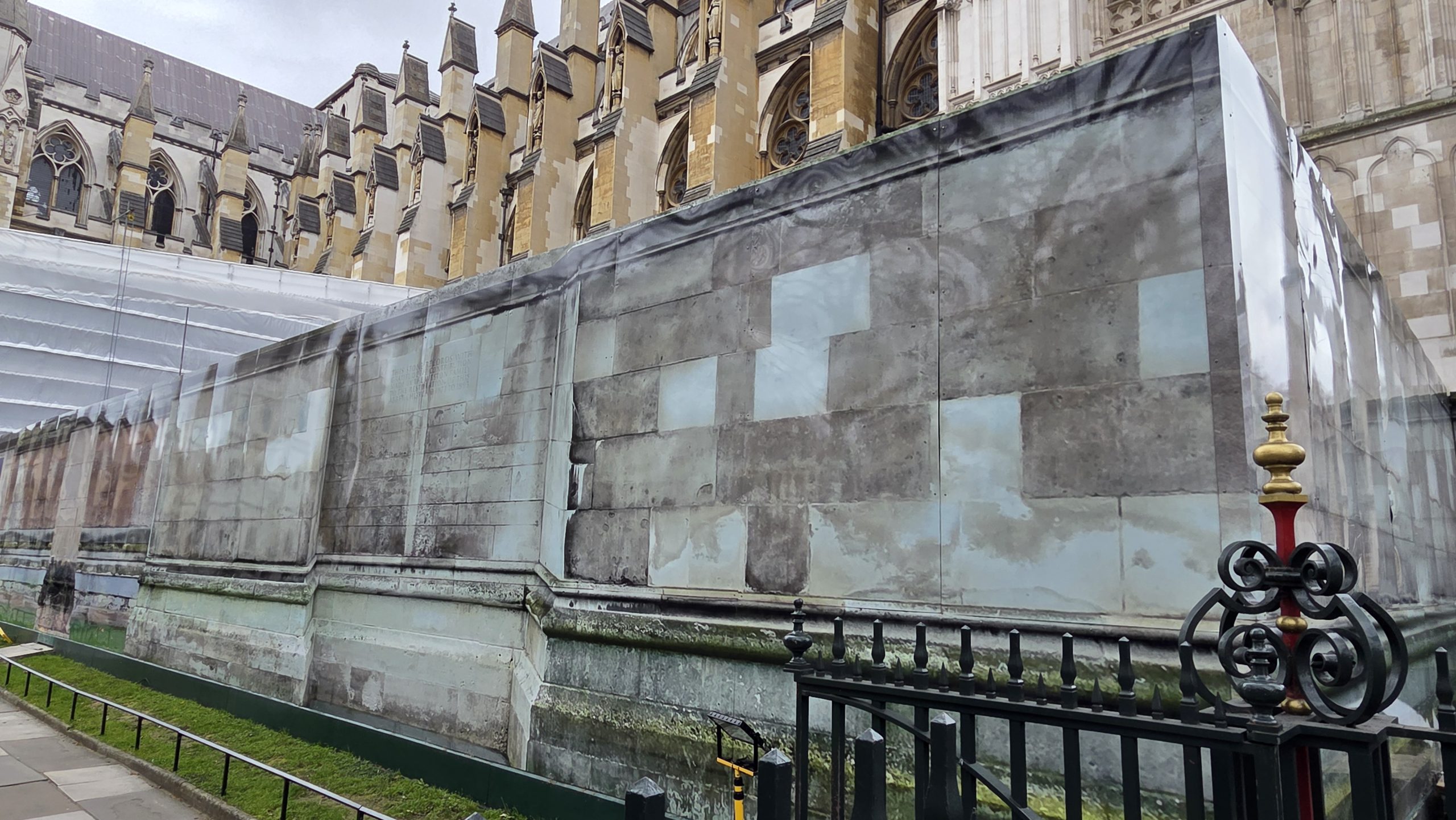
So encountering it six years later was genuinely surprising.
The first thing that stood out was the colour retention. While there has been some natural softening—inevitable over time—the print hasn’t suffered the kind of dramatic fading you might expect. The stone tones still feel authentic, the shadows retain depth, and the overall illusion remains intact. From a distance, it continues to blend convincingly with the surrounding architecture.
Up close, you can of course see signs of age. There are areas where the material has weathered slightly, and some subtle discoloration is visible, particularly along the lower sections where exposure to moisture and street-level grime is more intense. But even here, the degradation is relatively minor. Crucially, it hasn’t crossed the threshold where the print becomes an eyesore—in fact, it still serves its original purpose effectively.
That’s perhaps the most interesting aspect of seeing it again: the trompe l’oeil concept is still working. Despite being well beyond its intended lifespan, the hoarding continues to mitigate the visual impact of the construction behind it. It’s not invisible—no printed illusion ever truly is—but it significantly reduces the disruption. For many passersby, especially those not actively looking for it, the print likely still reads as an extension of the Abbey itself.
Westminster Abbey Printed Hoarding help reduce the eyesore construction site hoarding
This longevity speaks volumes about the quality of the materials and production methods used. Large-format print is often seen as temporary by nature, but projects like this demonstrate that, with the right approach, it can achieve a surprising degree of durability. The combination of high-resolution imagery, careful colour management, robust substrates, and UV-resistant inks has clearly paid off.
There’s also something to be said about the role of maintenance—or in this case, the lack of it. This hoarding hasn’t been actively preserved or refreshed over the years; it has simply endured. That makes its current condition even more impressive. It suggests that the initial investment in quality wasn’t just justified, but essential.
Of course, there’s a broader conversation here about expectations versus reality in outdoor installations. While guidelines might suggest a maximum lifespan of four years, real-world conditions can vary significantly. Orientation, exposure, foot traffic, and even micro climates around buildings all influence how materials age. In this instance, it seems the hoarding has benefited from a relatively favourable set of conditions—combined with robust production—to exceed those expectations.
Seeing the project again also brings a sense of perspective. In 2020, it was one job among many, albeit a notable one due to the location. At the time, the focus was on delivering a high-quality solution within a defined time frame. There’s rarely an opportunity to revisit such work years later and assess how it has truly performed over time.
And yet, here it is—still standing, still functioning, still quietly blending into one of the most iconic architectural settings in the world.
There’s a certain irony in the fact that a piece designed to go unnoticed has become, in its own way, noteworthy. Not because it draws attention to itself, but because it continues to avoid doing so. That, ultimately, is the success of a trompe l’oeil installation: not that people admire it directly, but that they barely register its presence at all.
Six years on, the hoarding at Westminster Abbey is a testament to what can be achieved when design intent, material quality, and execution come together effectively. It has exceeded its expected lifespan, maintained its visual integrity, and continued to serve its purpose in a demanding environment.
And for those of us involved in its creation, it offers a rare and satisfying moment—to see that something intended as temporary has, in its own understated way, endured.
For more information on Westminster Abbey Printed Hoarding or to see the other blogs on this printed hoarding visit here. Or for our latest project please visit our blog.