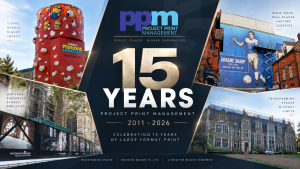
Fifteen years is a significant milestone for any business, and for Project Print Management (PPM) it gives us the perfect opportunity to look back at some of the projects, challenges and innovations that have shaped our company – while also looking ahead to what the next 15 years might bring and Future of Large Format Print.
When PPM started 15 years ago, large format digital printing was already developing quickly. Printing equipment was getting faster, materials were improving and clients were beginning to see that scaffolding, construction sites and temporary structures didn’t simply have to be hidden – they could become part of the visual landscape.
Since then, the industry has changed enormously.
During those 15 years, PPM has worked on everything from enormous building wraps and scaffold wraps to architectural trompe l’œil graphics, printed hoarding, bespoke banner systems and some genuinely unusual large format print installations.
Some projects have been memorable because of their size.
Others because of their location.
And some because, when we were first approached, there wasn’t an obvious solution.
That has always been one of the most enjoyable parts of Project Print Management.
We don’t simply ask, “How do we print it?”
We ask, “How are we going to make this work?”
15 Years of Solving Challenging Large Format Print Projects and Future of Large Format Print
Large format printing can appear relatively straightforward from the outside.
Create the artwork. Print it at a large size. Install it.
In reality, our projects are rarely that simple.
A successful building wrap or scaffold wrap can involve structural considerations, wind loading, specialist sub-frames, planning requirements, difficult access, artwork preparation, colour matching, print production, logistics and installation – often while the building or site remains fully operational.
The same applies to printed hoarding and specialist internal installations.
Sometimes we have to recreate architecture convincingly enough that a temporary structure almost disappears.
On another project we might need to design a printed solution around a glass lift shaft more than 30 metres high.
The print itself is only one part of the process.
PPM has always concentrated on managing the entire project, working alongside clients, architects, scaffold contractors, designers, developers, construction companies and specialist installation teams to turn an idea into something that can actually be manufactured and installed.
Over the past 15 years, that approach has taken us to some remarkable places.
Grosvenor Hotel, Park Lane – Making Construction Work Disappear
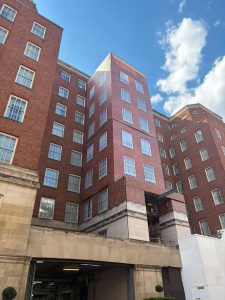
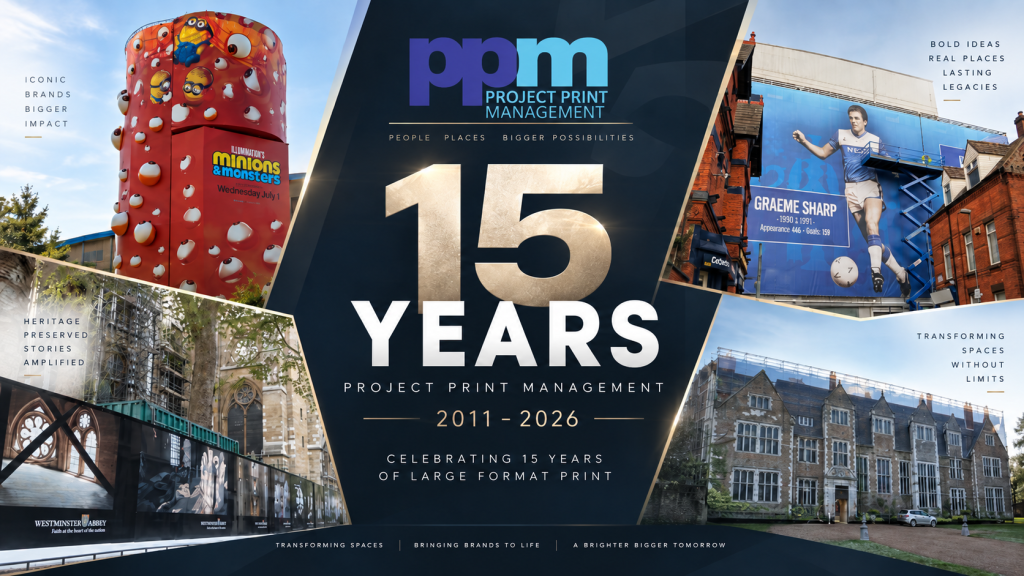
One of our more recent projects was the trompe l’œil scaffold wrap at the Grosvenor Hotel on Park Lane, London.
The challenge was to conceal the hoist and renovation works while maintaining the appearance of one of London’s most prominent hotels.
Rather than simply covering the area in plain scaffold sheeting, the solution was to recreate the appearance of the building itself.
The finished trompe l’œil wrap allowed the temporary construction structure to blend much more naturally with the architecture surrounding it.
But as with many PPM projects, the print was only part of the challenge.
The hotel remained operational throughout the project, meaning installation had to take place within strict working hours and with careful consideration for hotel guests and day-to-day operations.
A dedicated sub-frame was installed to keep the print properly tensioned and allow the wrap to continue around the sides, helping conceal the bungee fixings and producing a much cleaner finished appearance.
The wrap was also manufactured in three main sections.
This was because the construction programme required the wrap to be progressively removed from the top down as each level of work was completed.
It is an excellent example of what large format print has become.
It is not simply about printing something enormous.
It is print, engineering, access, design, logistics and installation all working together.
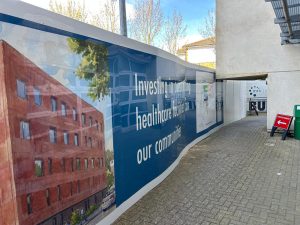
Westminster Abbey – Trompe l’Œil Hoarding at One of Britain’s Most Famous Buildings
Working at Westminster Abbey was undoubtedly one of the standout projects from PPM’s first 15 years.
When construction works are taking place at an internationally recognised historic building, simply putting up plain construction hoarding isn’t always the best answer.
The solution was a trompe l’œil printed hoarding designed to reproduce the architectural appearance of Westminster Abbey and help disguise the construction works behind it.
Creating convincing architectural graphics requires far more than simply taking a photograph and making it bigger.
Measurements and photography of the existing architecture have to be carefully considered before the images are edited for perspective, scale and colour. Architectural details then need to line up correctly when viewed from normal pedestrian positions.
For the Westminster Abbey project, the finished artwork was digitally printed onto aluminium composite panels, creating an impressive hoarding approximately 4 metres high and 87 metres long.
The design was intentionally kept relatively simple so that the architecture remained the dominant feature.
That was particularly important in a location visited by people from all over the world.
The purpose wasn’t to overwhelm the Abbey with advertising.
It was to make the construction environment sit more comfortably alongside one of the country’s most important historic buildings.
The Westminster Abbey project perfectly demonstrates why trompe l’œil printing can be so effective for heritage properties, prestigious developments and architecturally sensitive locations.
Instead of drawing attention to the construction works, the printed hoarding becomes part of the surroundings.
For us, having PPM’s work installed at Westminster Abbey remains a project we are extremely proud of.
The Minions Water Tower – When Large Format Print Becomes Something Completely Different
Some projects are memorable because of their complexity.
Others simply make people smile.
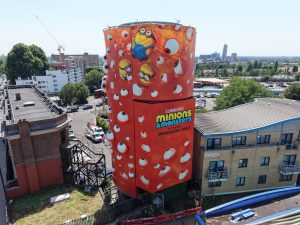
Our Minions Water Tower scaffold wrap certainly achieved that.
Wrapping a water tower is unusual enough.
Turning one into an enormous Minion takes things to another level.
It demonstrated perfectly what can happen when large format print, imagination and an unusual structure come together.
Instead of seeing scaffolding and construction works, the public saw a giant character towering over the surrounding area.
Projects like this remind us why large format print can be such a powerful medium.
Buildings, scaffolds and temporary structures provide enormous canvases.
With the right idea, they can become almost anything.
A construction scaffold can reproduce the building hidden behind it.
A blank elevation can become a huge advertising space.
And a water tower can become a Minion.
Fifteen years into PPM, it is still the variety of these projects that keeps the work interesting.
Kingston’s Ancient Market – Solving a Problem with Print and Engineering
Some of our most memorable projects haven’t involved enormous scaffold wraps at all.
Kingston’s Ancient Market is a perfect example.
The 29 permanent market stalls had up-and-over doors clad in timber. Unfortunately, the completed doors were too heavy for their mechanisms, causing operational problems and creating an ongoing issue.
PPM was asked to find a solution.
The challenge was to design and manufacture replacement garage doors that retained the same visual appearance but weighed approximately half as much.
That meant looking beyond conventional print.
A completely new door solution was developed and the replacement doors were wrapped to recreate the required timber appearance.
This project represents something that has been central to PPM throughout the last 15 years.
Start with the problem rather than the product.
Sometimes the answer is a printed scaffold wrap.
Sometimes it is an aluminium composite hoarding.
Sometimes it is a specialist banner system.
And occasionally it involves manufacturing 29 lightweight garage doors and wrapping them so they look like the originals.
Those are often the projects we enjoy most.
BNP Paribas – A Printed Protection Screen Inside a 30-Metre Glass Lift Shaft
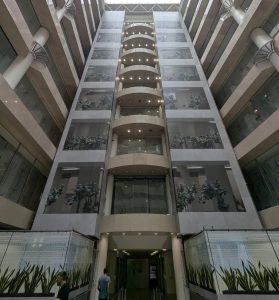
Another project that perfectly represents PPM’s approach was the lift shaft printed protection screen produced for BNP Paribas in Marylebone, London.
This was far from a conventional large format printing job.
The building contained five glass lifts positioned within two lift shafts, with two lifts at the front of the atrium and three located within the central section. The lift refurbishment programme was expected to continue for around ten months, with one lift being worked on at a time while the others remained operational.
Because the lifts and shafts were constructed from glass, the refurbishment work would otherwise have remained highly visible within the building.
The solution was to create a printed protection screen that could conceal the work taking place inside the lift shaft.
And this wasn’t being installed a few metres above the floor.
The printed protection solution extended within glass lift shafts reaching approximately 30 metres in height.
It is exactly the type of unusual project that demonstrates why large format print shouldn’t be thought of simply as banners and posters.
A client has a practical problem.
We look at the building, access, structure, visual requirements and installation constraints – and work out how print can form part of the solution.
That philosophy has been at the centre of PPM for 15 years.
What Has Changed During Those 15 Years?
The technology available to the large format print industry today would have been extraordinary when PPM started.
Printers have become faster.
Resolution and colour reproduction have improved.
Materials have evolved.
Artwork preparation and production workflows are increasingly automated.
Digital photography has become dramatically more sophisticated, while drones, laser scanning and 3D surveying technologies can now capture buildings in ways that would previously have involved considerably more manual work.
But we are now entering what could be the biggest technological shift yet.
Artificial intelligence.
AI is going to change large format printing.
The interesting question is not whether that will happen.
It is how we use it.
AI and the Future of Large Format Print
AI can already create images, manipulate photographs, generate concepts and expand artwork in ways that would have seemed impossible only a few years ago.
For companies involved in large format printing, the possibilities are enormous.
Imagine photographing a building and asking an AI system to produce ten different building-wrap concepts within minutes.
One could reproduce the original façade.
Another could transform it into a piece of public artwork.
Another might incorporate the developer’s branding.
Others could demonstrate different advertising concepts or alternative materials.
A client could see multiple realistic concepts before committing significant money to artwork or production.
That could fundamentally change the early design stage of a project.
AI Could Transform Trompe l’oeil Building Wraps
AI could become particularly useful for the type of trompe l’œil building wraps and hoardings PPM regularly produces.
In the future, we may be able to combine architectural drawings, site photographs, laser scans and 3D building models and allow AI to create much of the base artwork automatically.
The software could potentially identify windows, stonework, columns, brickwork and other architectural details and recreate missing areas of the façade.
It could correct perspective and lighting.
It could even generate sections of a building that are hidden behind existing scaffolding.
Projects such as Westminster Abbey or the Grosvenor Hotel could eventually involve AI-assisted workflows capable of producing incredibly realistic architectural reproductions considerably faster than traditional methods.
That doesn’t mean human designers become irrelevant.
Quite the opposite.
As generating imagery becomes easier, knowing which imagery is actually good becomes more important.
AI Can’t Change the Laws of Physics
This is something we believe will remain extremely important over the next 15 years.
An AI system can create an incredible visual concept.
But it can’t ignore the physical reality of installing it.
A huge building wrap still has to withstand wind.
The scaffold may still require additional bracing.
The print still needs a suitable sub-frame.
Fixing positions need to work.
Installation teams need safe access.
Materials need the correct fire performance.
And a 1,000-square-metre image that looks fantastic on a computer screen still has to be manufactured, transported to site and installed on a real building.
That practical understanding is where experience will remain enormously valuable.
The technology will change.
The fundamental challenge of turning an idea into a safe, practical installation will remain.
Future of Large Format Print: Sustainability Will Become Increasingly Important
Another major development over the next 15 years will be sustainability.
Clients are already becoming more interested in the materials used on projects, where those materials come from and what happens to them when an installation is removed.
We expect that trend to accelerate.
New recyclable substrates, PVC alternatives, improved inks and better recycling systems should all reduce the environmental impact of temporary graphics.
AI could contribute here as well.
Intelligent software could calculate the most efficient panel sizes, optimise cutting patterns, reduce waste, plan transportation and potentially recommend the most appropriate material according to the required lifespan of a project.
The future of large format print shouldn’t simply be about printing faster.
It should be about printing smarter.
What Will Future of Large Format Print Look Like in 2041?
Trying to predict exactly what our industry will look like 15 years from now is almost impossible.
Think how much technology has changed since PPM started and then imagine another 15 years of development.
By 2041, printed graphics could increasingly work alongside digital displays, interactive surfaces, augmented reality and technologies that don’t currently exist.
Perhaps buildings will combine printed façades with digital areas that change throughout the day.
Perhaps AI-generated artwork will be personalised to individual buildings or locations.
Perhaps materials will become fully recyclable or designed to be reused across multiple projects.
And perhaps some of the large format print installations we produce in 2041 would sound completely unrealistic today.
We rather hope so.
Because PPM has always enjoyed the unusual projects.
Future of Large Format Print: The Technology Changes – The Challenge Remains the Same
If there is one thing the last 15 years have taught us, it is that technology never stands still.
Printers will improve.
Materials will change.
Artificial intelligence will transform design and production.
Installation equipment will become more sophisticated.
Some of today’s processes may look incredibly old-fashioned by 2041.
But we suspect one thing won’t change.
A client will still contact us and say:
“We’ve got an idea. We’re not sure whether it can be done.”
And our response will hopefully still be:
“Let’s have a look.”
Because some of PPM’s best projects have started exactly that way.
Here’s to the Future of Large Format Print
Reaching 15 years gives us an opportunity to appreciate how far Project Print Management has come.
From trompe l’œil hoarding at Westminster Abbey and scaffold wraps on Park Lane to a giant Minions water tower, lightweight market-stall doors and a printed protection screen inside a 30-metre glass lift shaft, the variety of projects has been extraordinary.
We have worked on prestigious historic buildings, commercial properties, construction sites, public spaces and structures that were never designed with large format print in mind.
Along the way, we have worked with some fantastic clients, contractors, designers, scaffold companies, printers, installers and specialists.
Those relationships have played a huge part in what PPM has achieved.
And we’re still excited about what comes next.
Artificial intelligence will change the large format printing industry.
New materials will change it.
Sustainability will change it.
Better manufacturing and installation technology will change it.
But we believe those developments will create more opportunities rather than fewer.
If the industry has changed this much during our first 15 years, just imagine what we’ll be producing 15 years from now.
Thank you to everyone who has been part of Project Print Management’s first 15 years.
We are proud of what we have achieved, but we’re even more interested in what comes next.
Here’s to the next 15 years of Project Print Management – bigger ideas, smarter technology and, hopefully, plenty more projects that initially sound impossible. The Future of Large Format Print.