

Creating accurate Artwork for Building wrap projects is far more complicated than simply taking a photograph of a building and enlarging it. When the finished print is going to cover several storeys of scaffolding, even small errors in perspective, proportion or image quality become highly visible.
This is particularly challenging in central London, where buildings are often surrounded by narrow streets, neighbouring properties, trees, street furniture and heavy traffic. In many locations, it is simply impossible to stand far enough away from a building to photograph the complete elevation accurately.
At Project Print Management, producing lifelike Artwork for Building wrap installations is an important part of what we do. The aim is to create a finished scaffold wrap that replicates the architecture behind it so successfully that, from a normal viewing distance, the construction work becomes far less noticeable.
One project that demonstrated these challenges perfectly was St Margaret’s Church in Westminster.
Artwork for Building Wrap at St Margaret’s Church
Having previously completed work around Westminster Abbey, Project Print Management was asked to help produce a trompe l’oeil building wrap for St Margaret’s Church while its clock tower underwent extensive renovation.
The tower was expected to remain behind scaffolding for a considerable period, so rather than leaving the scaffold structure exposed, a decorative architectural wrap was chosen.
A trompe l’oeil building wrap uses a detailed printed representation of the building façade to disguise the scaffolding underneath. Windows, stonework, architectural features, shadows and proportions all need to line up correctly to create a convincing result.
However, producing the print is only one part of the process.
The success of the project starts with obtaining accurate photographic reference and creating sufficiently detailed artwork.
Why Building Wrap Photography Is So Difficult
Taking photographs from pavement level can work well for smaller buildings, but problems quickly appear when dealing with elevations more than 20 metres high.
A camera positioned close to a tall building naturally produces perspective distortion. Vertical lines converge and architectural features towards the top of the photograph become increasingly compressed.
Image-editing software such as Photoshop can correct a certain amount of perspective distortion, but there are limits.
Stretching and manipulating an image too aggressively can cause windows, stonework and decorative architectural details to look unnatural. Once that distorted artwork is enlarged to cover hundreds of square metres of scaffold, the problem becomes even more obvious.
Good Artwork for Building wrap therefore starts by capturing the building from the best possible position.
Surveying the Westminster Location
Before photography began, we surveyed St Margaret’s Church and considered how each elevation could be photographed.
One potential solution was to use a van-mounted access platform. This would allow the photographer to work at a greater height and reduce some of the perspective problems associated with taking photographs at street level.
Unfortunately, the surrounding Westminster location made this impractical.
For one elevation, the vehicle would have needed to be positioned around Parliament Square, requiring additional permissions and traffic management. Another elevation was obstructed by mature trees from the most practical photography position.
With scaffolding due to be installed shortly, there was also a limited window in which to capture the unobstructed elevations.
We therefore looked at another solution.

Using a Drone to Capture Building Wrap Artwork
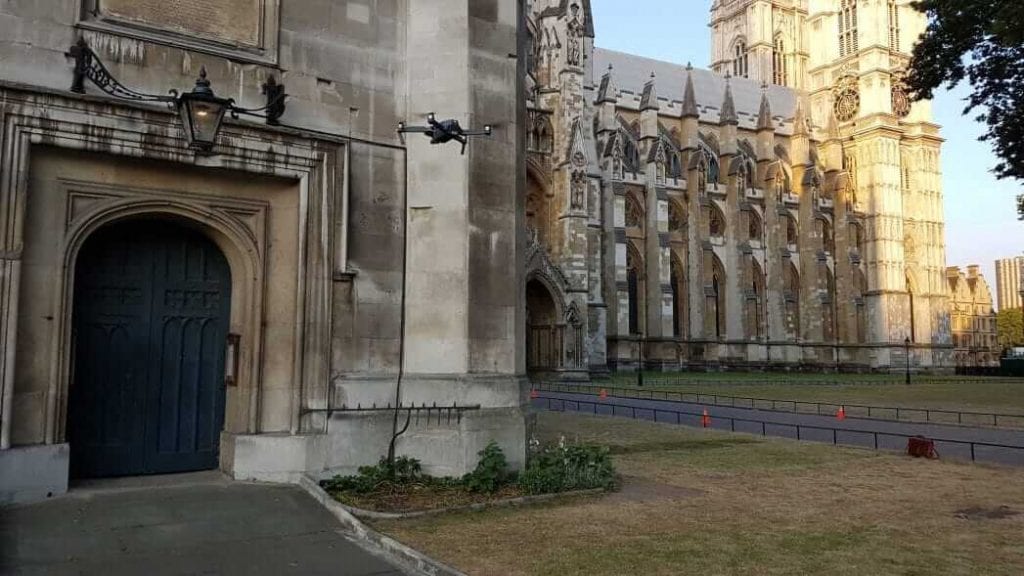
A high-resolution camera drone provided the most practical way of photographing the elevations.
Rather than attempting to correct extreme perspective afterwards, the drone could be positioned at different heights around the tower. This allowed the camera to capture architectural details from a much more appropriate angle.
It also gave us multiple images that could later be carefully combined, corrected and prepared to create the final Artwork for Building wrap.
However, flying a drone in Westminster presented another significant challenge.
St Margaret’s Church is situated beside Westminster Abbey and directly opposite the Houses of Parliament. It is one of the most sensitive locations in central London for drone operations.
At the time the project was undertaken, a number of permissions and approvals were required before the flight could take place. These included permission associated with the Westminster site, airspace requirements and coordination with the relevant security and aviation authorities.
The regulatory framework for UK drone operations has changed since this project was completed. Anyone undertaking similar commercial drone photography today should check the latest Civil Aviation Authority requirements and any location-specific airspace restrictions before flying.
A Very Small Window for Photography
Timing became critical.
By the time the necessary site approval had been received, we had approximately one week before the scaffolding was scheduled to go up. Once scaffold and sheeting covered the tower, obtaining the photographs needed to produce an accurate replica of the building would become extremely difficult.
After the relevant permissions for the original flight were secured, photography began at approximately 5am.
Fortunately, conditions were excellent.
The morning was clear with relatively little wind, giving the drone team the stability and visibility needed to capture the architectural details accurately.
Photography took approximately an hour and a half. Multiple viewpoints and elevations were recorded, providing the raw imagery required to begin constructing the building wrap artwork.
We also had a short opportunity to capture some spectacular 4K video footage around Westminster Abbey.
Turning Photography into Lifelike Building Wrap Artwork
Capturing the photographs is only the beginning.
The images then need to be corrected, aligned and carefully combined to recreate the complete building elevation. Perspective, scale, colour and architectural features all need to work together.
The finished file also has to contain enough image information to reproduce successfully at an enormous scale.
Once printed, installation becomes equally important.
A beautifully prepared piece of Artwork for Building wrap can quickly lose its impact if the material is poorly tensioned, fixings are clearly visible or creases run through important architectural features.
The printing, sub-frame and installation therefore need to be considered alongside the artwork from the beginning of the project.
Creating Building Wraps That Blend into Their Surroundings
The ultimate goal of a trompe l’oeil scaffold wrap is simple: make the temporary construction structure as unobtrusive as possible.
Achieving that result requires much more than large-format printing.
It combines site surveying, photography, artwork preparation, colour management, large-format print production and specialist installation.
Projects such as St Margaret’s Church demonstrate why professional Artwork for Building wrap is so important. By capturing the original architecture accurately and reproducing it at full building scale, scaffolding can be transformed from an unavoidable construction feature into something that respects the appearance of the building and its surroundings.
For historic buildings, hotels, commercial properties and high-profile developments, a carefully produced architectural building wrap can make an enormous difference throughout the renovation period.
For more information on Artwork for building wrap please contact us or visit or blog page for our latest work.