An Artistic backdrop can completely transform the appearance of a space, building or temporary structure. From disguising construction work and improving the townscape to creating dramatic scenery for theatre, television, film and events, large-format printed backdrops offer enormous creative potential.
When the aim is to create a realistic, lifelike appearance, successful artwork relies on much more than simply printing a large image. Perspective, scale, colour, architectural detail and the surrounding environment all need to work together to create a convincing visual effect.
One of the most effective techniques used to create this illusion is known as trompe l’oeil.
What Is a Trompe l’Oeil Artistic Backdrop?
Trompe l’oeil is a French term meaning “deceive the eye.” It describes an artistic technique designed to make a flat image appear three-dimensional or realistic enough that the viewer initially believes they are looking at the real thing.
The technique has been used by artists for centuries to create architectural features, windows, doors, columns, landscapes and other objects that appear to have depth even though they are painted or printed onto a flat surface.
When used as an Artistic backdrop, trompe l’oeil can create the illusion of an entire building façade, landscape or architectural environment.
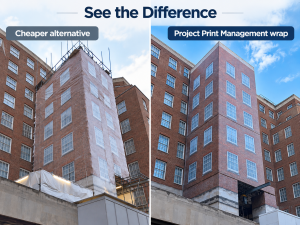
For construction projects, for example, a printed scaffold wrap could reproduce the appearance of the finished building while renovation work continues behind it. On a film set, the same principles can be used to create an apparently distant landscape, street scene or architectural environment without physically constructing everything shown in the image.
The History of Trompe l’Oeil
The origins of trompe l’oeil are often traced back to Ancient Greece.
One famous story describes a competition between the artists Zeuxis and Parrhasius. Zeuxis supposedly painted grapes so realistically that birds attempted to eat them.
Parrhasius then presented what appeared to be a curtain covering his painting. When Zeuxis asked him to remove the curtain, he discovered that the curtain itself was actually the painting.
Whether interpreted as history or legend, the story illustrates the central principle behind trompe l’oeil: creating artwork realistic enough to temporarily confuse the viewer.
The technique continued to develop over the centuries and became particularly important during the Renaissance.
Artists used painted architectural details and perspective to make walls and ceilings appear much larger than they really were. Churches, palaces and other important buildings often incorporated elaborate ceiling paintings designed to create the impression of greater height or even an opening into the sky.
Perspective, shadow and carefully positioned architectural details allowed artists to create a convincing illusion of depth.

Trompe l’Oeil in the Modern World
Today, trompe l’oeil techniques continue to be used across many different creative industries.
Street artists create extraordinary three-dimensional pavement artwork that appears to contain holes, waterfalls, staircases and objects rising from the ground.
Interior designers use printed wallpaper and murals to create the illusion of windows, architectural features or landscapes.
Film and television productions use large scenic backdrops to create environments that would otherwise be expensive or impractical to construct.
The technique is also extremely effective within the construction industry.
A carefully designed Artistic backdrop can disguise scaffolding, temporary structures or renovation work while maintaining the visual appearance of the surrounding area.
This is particularly valuable on prestigious buildings, historic properties, hotels, retail developments and locations where appearance needs to be maintained throughout construction.
Artistic Backdrops for Building Wraps
Large-format digital printing has made it possible to reproduce extremely detailed artwork across enormous areas.
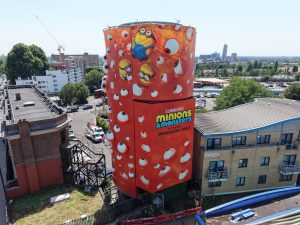
A building wrap can cover hundreds or even thousands of square metres, turning scaffolding or temporary structures into a highly detailed visual display.
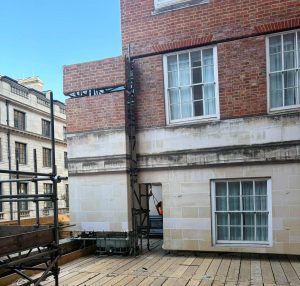
For refurbishment projects, artwork can reproduce the architecture of the building hidden behind the scaffold.
Windows, stonework, columns, brickwork and decorative features can all be incorporated into the design.
From a suitable viewing distance, the resulting Artistic backdrop can dramatically reduce the visual impact of construction work.
The effectiveness of the finished installation depends heavily on accurate design and positioning.
Architectural features need to align correctly with the building, while the print itself must be installed under the correct tension to prevent distortion.
Artistic Backdrops for Events, Theatre, TV and Film
Large-format printed backdrops are also ideal for temporary events and entertainment productions.
They can be used for:
- Theatre stage scenery
- Television studios
- Film sets
- Exhibitions
- Corporate events
- Festivals
- Product launches
- Photography backgrounds
- Experiential marketing installations
Digital printing allows detailed artwork to be produced quickly and at virtually any scale.
Depending on the application, the backdrop can be printed onto materials including PVC banner, mesh, fabric or specialist display media.
Additional physical props can also be positioned alongside the printed artwork to increase the illusion of depth and create an even more realistic environment.
Creating a Successful Artistic Backdrop
A successful Artistic backdrop begins with understanding how the finished installation will be viewed.
Viewing distance, perspective, lighting and surrounding architecture all influence how the artwork should be designed.
For building wraps, accurate measurements are particularly important. Doors, windows, columns and architectural features need to be positioned correctly so that the printed image appears natural when installed.
Print quality is equally important, but installation should never be overlooked.
Even excellent artwork can lose its impact if the material is loose, distorted or poorly aligned.
Professional installation ensures that large-format prints remain properly positioned and tensioned.
Artistic Backdrop Design, Print and Installation
At Project Print Management, we provide complete design, print and installation solutions for large-format Artistic backdrop projects.
Our experience includes trompe l’oeil building wraps, printed scaffold coverings, construction site graphics, hoarding displays and large-format visual installations.
Every project requires a slightly different approach.
We can work with supplied artwork or help develop a concept that complements the surrounding architecture and viewing environment.
Where appropriate, printed graphics can also be combined with physical props or structural elements to make the finished installation even more convincing.
Whether the objective is to disguise construction work, enhance a building, create scenery for a production or transform an event space, a professionally designed artistic backdrop can turn an ordinary temporary surface into something visually impressive and memorable.
For more information on artistic backdrop please click here. For our latest print project please visit our blog page.