Protective Aluminium Print: Preserving Listed Buildings During Construction
Protecting historic architecture during modern construction work is one of the most delicate challenges in the built environment. Listed buildings are irreplaceable, and even temporary damage can result in permanent loss to our shared heritage. At Project Print Management, we are increasingly asked to provide solutions that do more than simply shield surfaces — they must respect the building’s character, work within tight spatial constraints, and often appear almost invisible to the public.
One such project involved the use of protective aluminium print to safeguard a distinctive Edwardian façade on a highly sensitive site in London. The building in question was not only listed, but historically significant, with a past that stretched from early 20th-century transport infrastructure to its use as a Second World War bunker.
A Unique and Constrained Site
The project was commissioned by Leander Construction Company, who were undertaking essential works at an old underground station entrance. The station had closed to the public in 1932, but during the Second World War it was repurposed as a bunker used by Winston Churchill and senior officials — adding another layer of historical importance to the site.
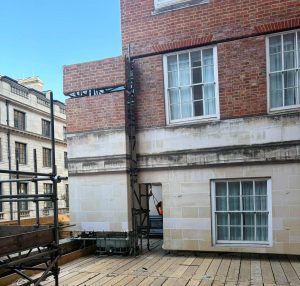
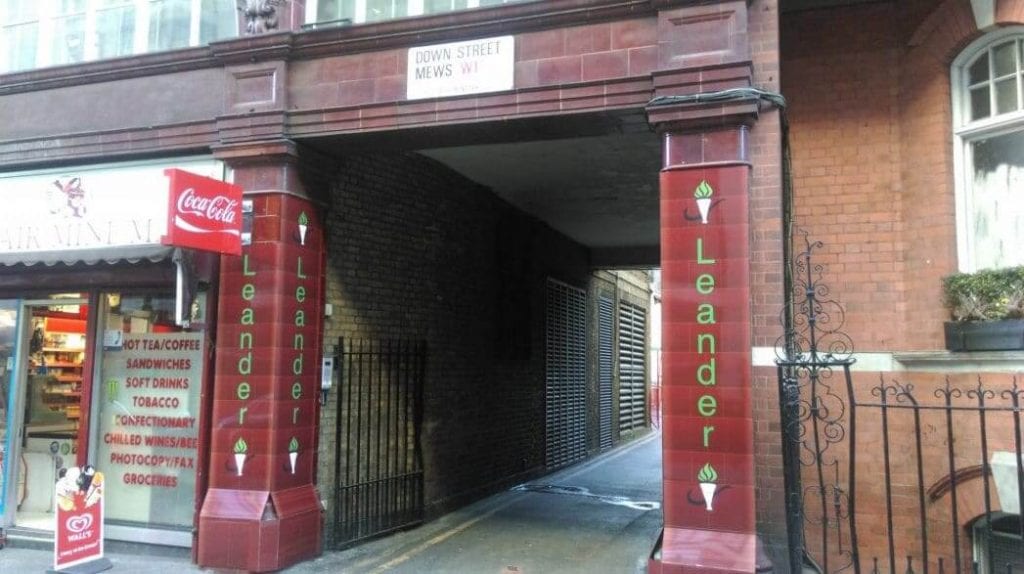
Unlike many construction projects involving heritage buildings, this site presented a significant logistical challenge: space was extremely limited. Large construction vehicles and trucks needed to pass through a narrow entrance framed by original Edwardian architectural features, including distinctive glazed fascia tiles.
Traditional protective methods — such as timber boxing or scaffold sheeting — were simply not viable. They would have reduced the already limited clearance and increased the risk of accidental impact. What was needed was a solution that offered robust protection without adding bulk, while also maintaining the building’s appearance.
The Brief: Protection Without Visual Disruption
Project Print Management was tasked with designing and installing a protective system that would:
-
Shield the original listed façade tiles from impact and abrasion
-
Fit closely to the existing architectural forms
-
Allow heavy vehicles to pass safely through the entrance
-
Avoid any permanent fixing or damage to the building
-
Visually blend in with the original façade
In essence, the protection needed to do its job quietly — preserving the building without drawing attention to itself.
Why Protective Aluminium Print Was the Right Solution
After a detailed site survey and consultation with the construction team, we recommended the use of digitally printed aluminium composite panels as a protective layer.
This approach offered several key advantages:
Slim but Strong
Aluminium composite material (often referred to by brand names such as Dibond or Alupanel) consists of two thin aluminium skins bonded to a polyethylene core. At just 3mm thick, it provides excellent rigidity and impact resistance without taking up valuable space.
Lightweight and Easy to Fabricate
Despite its strength, aluminium composite is lightweight and can be accurately cut and shaped. This allowed us to fabricate panels that followed the contours of the building’s pillars and façade details with precision.
Excellent Print Quality
The smooth aluminium surface provides an ideal substrate for high-resolution digital printing. This made it possible to recreate the look of the original Edwardian tiles with remarkable accuracy.
Temporary and Reversible
Crucially for listed buildings, aluminium composite panels can be installed using non-invasive fixing methods and removed cleanly at the end of the project.
This combination made protective aluminium print the most appropriate and sensitive solution for the site.
Recreating the Original Façade Through Print
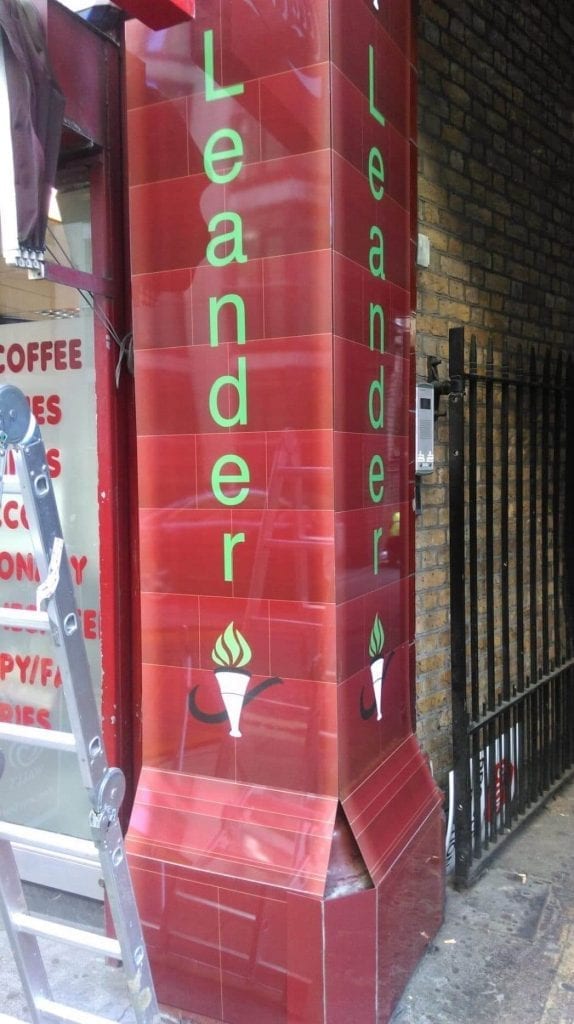
One of the most challenging aspects of the project was ensuring that the protective panels visually mimicked the existing tiled fascia.
The original tiles were distinctive in both colour and pattern — an important architectural feature that contributed to the building’s historic character. Covering them with plain boards would have been visually jarring and unacceptable in such a prominent location.
Our design team worked closely with high-resolution photography and colour matching techniques to recreate the tile pattern digitally. This involved careful attention to:
-
Colour accuracy under natural daylight
-
Scale and alignment of the tile pattern
-
Subtle variations and imperfections that give historic materials their character
The goal was not to make a bold statement, but to allow the protective panels to recede into the background. When installed, the protective aluminium print blended so effectively with the original façade that it was barely noticeable to passers-by — exactly as intended.
Installation on a Listed Building: Precision and Care
When working with historic structures, installation is just as important as design and materials. Any fixing method must be secure enough to withstand site conditions, yet gentle enough to avoid damage.
For this project, the aluminium composite panels were installed using 3M VHB (Very High Bond) tape. This specialist adhesive tape is widely trusted in architectural and construction applications and was ideal for several reasons:
-
It provides a strong, even bond across the surface
-
No drilling or mechanical fixings were required
-
It does not damage the substrate when correctly removed
-
It allows for clean removal once the construction phase is complete
Each panel was carefully positioned to ensure full coverage of the vulnerable areas while maintaining accurate alignment with the printed tile design. The installation process was carried out methodically to ensure that no pressure or abrasion was applied to the original tiles beneath.
Protection That Supports the Construction Process
From a practical standpoint, the protective aluminium print allowed Leander Construction Company to carry out their work more efficiently and with greater confidence.
With the façade protected:
-
Large vehicles could pass through the entrance without constant risk assessments
-
Site managers could focus on logistics rather than heritage concerns
-
The risk of costly damage or delays was significantly reduced
In environments where heritage protection is critical, preventative measures like this are not just cosmetic — they are essential to keeping projects on schedule and compliant with conservation requirements.
A Growing Need in Urban Construction for Protective aluminium print
As cities continue to evolve, construction work around listed and historic buildings is becoming increasingly common. In dense urban environments, there is often very little room to manoeuvre, and traditional protective methods are no longer sufficient.
Projects like this demonstrate how protective aluminium print can play a vital role in bridging the gap between modern construction needs and heritage preservation. It offers a solution that is:
-
Visually sensitive
-
Structurally effective
-
Reversible and non-invasive
-
Suitable for tight or high-risk locations
This approach is particularly valuable for entrances, façades, columns, and decorative elements that are both fragile and prominent.
The Outcome: Protection Without Compromise with Protective aluminium print
The finished installation achieved exactly what the client and conservation requirements demanded. The Edwardian tiles were fully protected throughout the construction phase, heavy vehicles passed through safely, and the visual integrity of the listed building was preserved.
Most importantly, once the works are complete, the panels can be removed cleanly — leaving the original façade exactly as it was before construction began.
Expertise You Can Trust for your Protective aluminium print
At Project Print Management, we specialise in print-led solutions that solve real-world construction and architectural challenges. From protective applications to large-scale graphics, our work is always guided by the same principles:
-
Respect for the building and its context
-
Careful material selection
-
Precision design and installation
-
Collaboration with contractors and consultants
If you’re working on a project involving a listed or sensitive building and need a discreet, effective way to protect architectural features, we’re here to help.
Talk to Us About Protective Aluminium Print
Whether your project involves heritage conservation, restricted access, or temporary protection during construction, our team can advise on the most suitable approach.
Project Print Management: Protective aluminium print
Protecting architecture through intelligent print solutions.
For more information on innovative print solutions please contact us. Or for our latest print projects please visit our blog page.