Construction sites often present a challenge when it comes to maintaining both safety and visual appeal. At Project Print Management, we specialise in creating printed hoarding boards that do more than just hide building works—they can inform, educate, and engage the public. One recent example is our project at St John’s School, where printed hoarding boards transformed a temporary construction barrier into a compelling display of the school’s 167-year history.
Enhancing a Construction Site at St John’s School with Printed Hoarding Boards
St John’s School in Leatherhead, Surrey, is an independent school with a rich heritage. The school recently began construction on a new six-lane, 25-meter competition standard swimming pool to replace the existing facility. The project, set to take over a year to complete, required extensive site hoarding to ensure the safety of students, staff, and visitors.
Rather than leaving plain barriers around the site, the school chose to transform the hoarding into a printed timeline of the school’s history, creating an informative and visually attractive display. The boards served multiple purposes:
- Acting as a prospectus for prospective parents and visitors
- Enhancing the visual appearance of the site
- Educating students, staff, and the local community about the school’s heritage
This approach highlights how construction site hoarding can be a marketing and educational tool, rather than just a practical necessity.
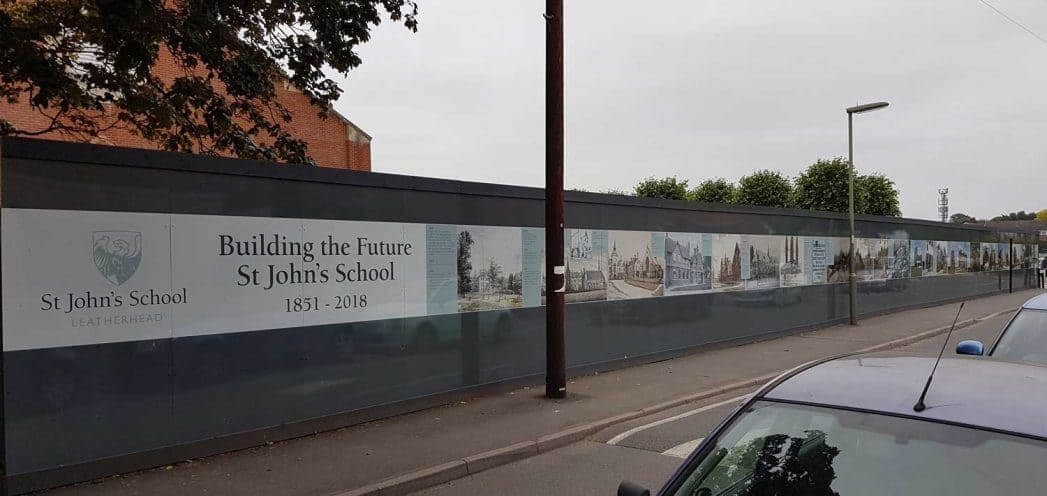
Collaboration and Creative Design
To ensure historical accuracy and engaging storytelling, we collaborated closely with the school’s archivist. Together, we developed a creative design that presented St John’s School’s 167-year history in a visually compelling and easily digestible format.
The design incorporated:
- Key milestones in the school’s development
- Photographs and archival images
- Illustrative timelines to show the evolution of the school
- Cohesive typography and layout for readability
This process ensured that each hoarding board was not just a barrier but also a piece of storytelling, celebrating the school’s heritage while students and visitors passed by daily.
High-Quality Printed Hoarding Boards
For longevity and durability, the printed hoarding boards were digitally produced at high resolution onto 3mm thick aluminium composite panels. This material is ideal for outdoor use due to its robustness, weather resistance, and ability to maintain crisp print quality over time.
To provide additional protection against daily wear, the boards were over-laminated with an anti-graffiti film. While the film does not prevent graffiti entirely, it allows any markings to be easily removed using mild chemicals, such as nail varnish remover, without damaging the print underneath. The laminate also protects against abrasion during cleaning and handling, ensuring the boards remain visually appealing throughout the construction project.
The History of St John’s School
The hoarding boards featured a detailed timeline of St John’s School, highlighting its long-standing contribution to education.
- Founded in 1851 by Ashby Haslewood, vicar of St Mark’s, Hamilton Terrace in St John’s Wood, London. Haslewood aimed to provide free education for the sons of poor clergymen and to supply a choir for his large church.
- The school remained primarily a charity school until the headmastership of Arthur Rutty (1883–1909), when it developed the characteristics of a public school and began attracting fee-paying families while continuing to serve sons of clergymen.
- Over the years, St John’s School continued to expand and modernise its offerings.
- In 1989, the first Sixth Form girls were admitted, marking the beginning of co-educational expansion.
- In 2010, girls joined the Fourth Form for the first time, and by 2012, the school became fully co-educational.
- September 2016 saw the opening of the new Lower School, welcoming Year 7 pupils for the first time.
By integrating these historical highlights into the hoarding boards, the construction site became an educational display, celebrating the school’s legacy while maintaining an attractive presence on campus.
Benefits of Using Printed Hoarding Boards
This project illustrates the many advantages of using printed hoarding boards for construction projects:
1. Transforming Safety Barriers into Educational Tools
Hoardings are essential for site safety, but with printed graphics, they can become a medium for storytelling and education. St John’s School used its hoarding to showcase its 167-year history, enriching the environment for visitors and students alike.
2. Enhancing Site Aesthetics
Construction sites can often appear chaotic and unattractive. High-quality printed boards improve the visual appeal of the site, creating a professional, polished look that reflects positively on the institution or business undertaking the project.
3. Marketing and Communication Opportunities
Printed hoarding boards can double as marketing materials. They provide a unique opportunity to present brand identity, highlight achievements, or communicate project progress to the public. For St John’s, the hoarding acted as an on-site prospectus for prospective parents, offering them a first impression of the school’s rich heritage.
4. Durability and Protection
Aluminium composite panels with anti-graffiti lamination ensure that the hoarding boards withstand outdoor conditions, including weather, dust, and minor abrasions. The result is a lasting display that remains clean and visually appealing for the duration of the construction project.

Designing Printed Hoarding Boards: The Process
Producing printed hoarding boards requires careful planning and attention to detail. The process typically involves:
- Site Assessment and Measurements
Ensuring panels fit perfectly across the hoarding while considering structural elements and sight lines. - Photography and Archival Research
High-resolution images are captured, and historical or relevant visuals are sourced, particularly for heritage projects. - Artwork and Design
Images are refined digitally to correct perspective, scale, and colour. Elements that may detract from the design, such as bins or signage, are removed. - Printing and Finishing
Panels are printed on durable aluminium composite boards and over-laminated with protective films to ensure longevity. - Installation
Boards are mounted securely onto the site hoarding, with attention to alignment, consistency, and seamless visual effect.
This methodical approach ensures that each printed hoarding board achieves maximum impact, combining safety, functionality, and aesthetic appeal.
Large Format Printing and Educational Value
Using large format printing technology allows the creation of detailed, visually striking graphics that engage viewers at a distance. For St John’s School, this meant:
- Archival photographs could be enlarged without losing detail
- Text and timeline elements were legible from a distance
- Panels provided an immersive, educational experience
By leveraging this technology, printed hoarding boards become more than a temporary construction feature—they act as a public-facing information resource.
Protecting Your Investment with Printed Hoarding Boards
Construction projects can span months or even years, and site hoardings are often exposed to outdoor conditions for extended periods. Using robust materials such as aluminium composite and protective over-lamination ensures that printed hoarding boards:
- Retain vibrancy and clarity throughout the project
- Resist minor vandalism
- Withstand exposure to sunlight, rain, and wind
- Maintain a professional appearance from installation to removal
This investment not only safeguards the printed graphics but also contributes to the overall perception of the school or project.
Why Choose Project Print Management for Printed Hoarding Boards
Project Print Management specialises in large-format graphics and site hoarding solutions across London and the South East. Our expertise covers:
- Consultation and design advice for maximum impact
- High-resolution photography and archival image enhancement
- Large format digital printing on durable, weatherproof materials
- Protective lamination’s to extend board longevity
- Professional installation ensuring clean, aligned, and visually appealing results
Each project is treated individually, ensuring that the finished printed hoarding boards meet client expectations for quality, aesthetics, and functionality.
Turning Construction into an Opportunity
The renovation of the swimming pool at St John’s School illustrates how construction hoardings can be transformed into educational, attractive, and engaging displays. By using printed hoarding boards, Project Print Management helped the school:
- Enhance the site’s visual appeal
- Communicate its history and values
- Create a prospectus-like experience for prospective parents
- Protect the hoarding against weather and vandalism
Construction projects do not have to appear disruptive or unattractive. With high-quality printed hoarding boards, safety, functionality, and aesthetics can be seamlessly combined, creating a lasting impression on visitors, the local community, and stakeholders alike.
For more information on printed hoarding boards or to view our latest projects, contact Project Print Management today. We specialise in turning construction barriers into impactful and informative visual experiences.
For more information on Printed hoarding boards please contact us or visit our blog for our latest projects.