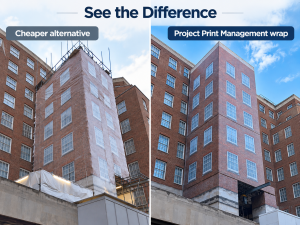

A professionally produced facade scaffold wrap can completely transform the appearance of a building during refurbishment. Rather than leaving scaffolding, hoists and construction equipment exposed for months at a time, a realistic printed facade can help disguise the temporary works and maintain the appearance of the property.
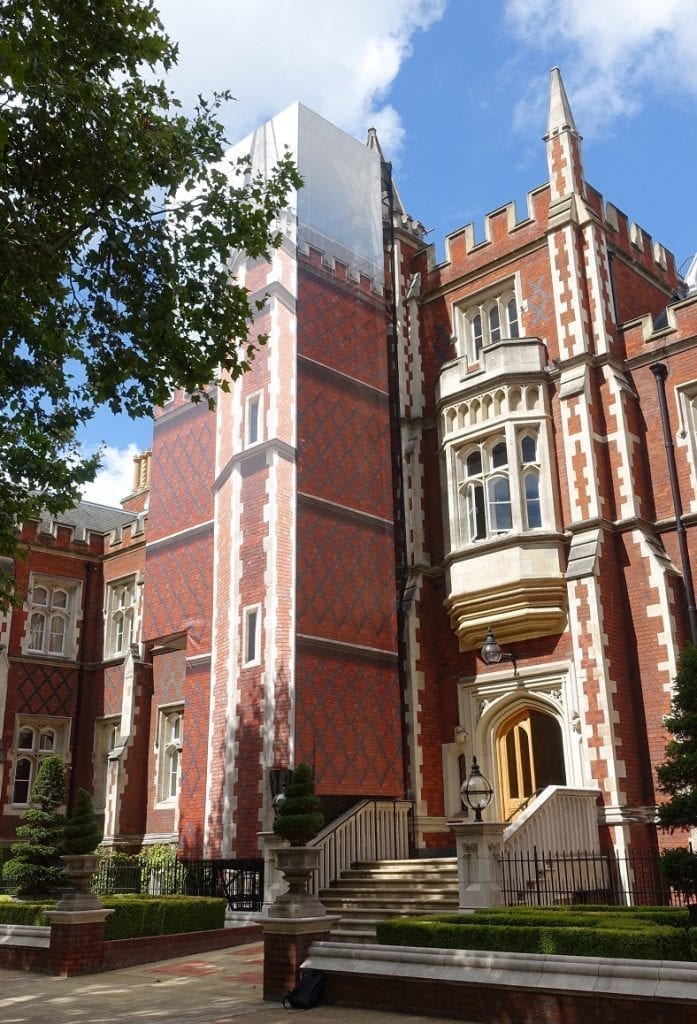
This project at The Bromptons in London is an excellent example of how a high-quality facade scaffold wrap should look when the design, sub-frame, printing and installation are all carefully coordinated.
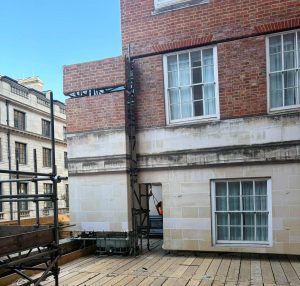
Our brief was to hide scaffolding that had been installed to house a construction hoist while renovation work was carried out. The scaffold and hoist were expected to remain in position for approximately 18 months, so leaving the structure uncovered would have created a significant visual impact for residents living within this prestigious development.
The solution was to design and produce a large-scale printed scaffold wrap that replicated the appearance of the existing building facade.
The aim was simple: make the temporary structure blend into the building as naturally as possible.
Teamwork Is Essential for a Facade Scaffold Wrap
A successful facade scaffold wrap starts long before the print is produced.
One of the most important elements is the sub-frame.
The sub-frame provides the structure that supports the printed banner and allows it to be tensioned correctly. If the frame is uneven, incorrectly positioned or poorly constructed, even the best printed artwork will struggle to create a convincing finish.
On this project, the client wanted to use their existing scaffolding contractor to manufacture and install the sub-frame.
To ensure the structure was built correctly, Project Print Management provided an experienced supervisor on a day-rate basis to work alongside the scaffold team. Our supervisor helped train and assist the contractor’s staff while the frame was being constructed.
This collaborative approach allowed the client to use their preferred scaffolding company while still benefiting from our specialist knowledge of large-format scaffold wraps.
Once the sub-frame had been completed, our supervisor carried out a detailed survey.
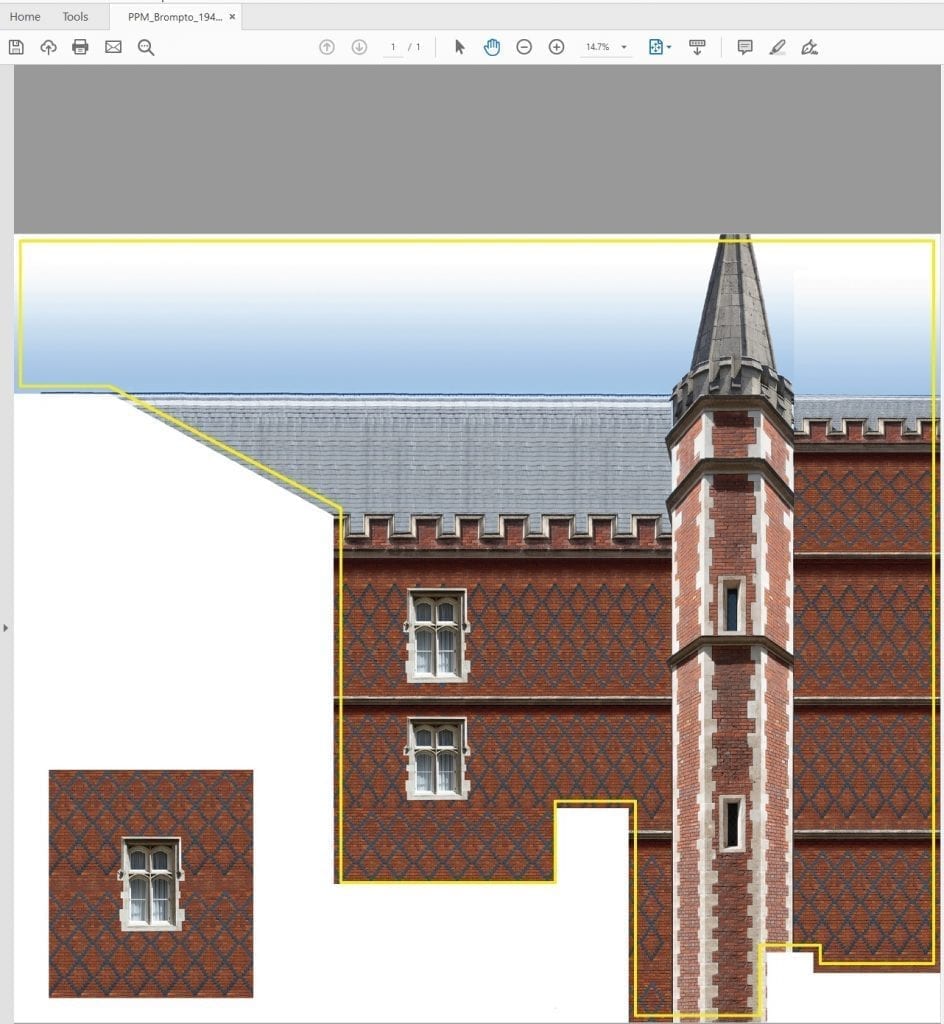
The survey information was then supplied to our artwork team so they could create an accurate template for the printed facade.
-
 Preparing Artwork for a Facade Scaffold Wrap
Artwork preparation is one of the most important stages of producing a realistic facade scaffold wrap.
The objective is not simply to print a photograph of the building at a large scale. The artwork needs to be adjusted so the finished facade appears believable when viewed from ground level and from surrounding properties.
Photography can be particularly challenging on tall buildings.
When photographing a high elevation from street level, perspective distortion naturally occurs. Vertical lines can appear to lean backwards and upper floors may look narrower than those closer to the camera.
This distortion has to be corrected during the artwork process.
Our artwork team adjusts scale, perspective, colour and architectural proportions so the printed graphic closely represents the original building.
However, there is also a balance to achieve.
It is not always necessary to reproduce every tiny architectural detail unless the project is for a heritage exhibition, conservation scheme or another application where precise historical accuracy is required.
For most facade scaffold wraps, the ultimate goal is to make the temporary covering appear as though it belongs within the surrounding architecture.
Windows, stonework, brickwork, decorative features and shadows all need to work together visually.
A successful design should complement neighbouring buildings and blend into the surrounding streetscape rather than drawing unnecessary attention to the scaffolding behind it.
Digital Printing the Facade Scaffold Wrap
Once the artwork had been approved, the facade scaffold wrap was digitally printed using a five-metre-wide super-wide-format printer.
Mesh PVC was selected for the project.
Mesh is widely used for large scaffold wraps because its perforated structure allows some air to pass through the material, making it suitable for large external installations where wind loading needs to be considered.
The perimeter of the printed panels was heavily reinforced to provide the strength required for a long-term installation.
Large eyelets with approximately 14mm internal holes were installed at 300mm centres through a reinforced edge. The perimeter construction incorporated a roped edge pocket, folded material and webbing, all secured using high-frequency welding.
Additional rear fixing strips were positioned vertically at approximately five-metre
These were reinforced with webbing and fitted with large eyelets at approximately 500mm centres. The rear fixing points allow the centre sections of large printed panels to be supported, helping reduce movement and maintain a smooth, tensioned appearance.
For a scaffold wrap of this scale, these finishing details are extremely important.
The print itself may create the visual effect, but the finishing system and installation method determine how well the wrap performs once it is exposed to outdoor conditions.
Creating a Wrap That Blends Into the Building
The effectiveness of a facade scaffold wrap should ultimately be judged by how well it disguises the temporary structure behind it.
When viewed from a reasonable distance, the printed building elevation should appear natural enough that the scaffolding and construction works become far less noticeable.
This is particularly important on prestigious residential, commercial and heritage properties where refurbishment work may continue for many months.
A carefully designed architectural scaffold wrap can help maintain the visual appearance of the building throughout the construction programme.
The History of The Bromptons
The Bromptons also provided an interesting architectural setting for this project.
The site was originally developed as a hospital during the nineteenth century on approximately three acres of land that had previously been used as a market garden.
The foundation stone for the hospital was laid by Prince Albert in June 1844. Queen Victoria supported the hospital and visited on several occasions, with her signature preserved in the building’s historic visitor records.
The property was later sympathetically redeveloped by Northacre PLC in 1997.
The redevelopment focused on preserving the architectural character of the original hospital while converting the buildings into a prestigious residential development.
Many of the original architectural features were retained, making it particularly important that any temporary scaffold covering respected the appearance of the historic building.
Specialist Facade Scaffold Solutions
Producing a convincing facade scaffold wrap requires a combination of accurate surveying, specialist sub-frame construction, photography, artwork preparation, large-format printing and professional installation.
When each stage is carried out correctly, scaffolding can be transformed from an unattractive construction necessity into a temporary architectural facade that blends with the building behind it.
Project Print Management specialises in large-format scaffold wraps, trompe l’oeil building wraps and printed architectural facades for refurbishment and construction projects throughout the UK.t
For more information on facade scaffold wrap please click here, or for our latest print projects please visit our blog.