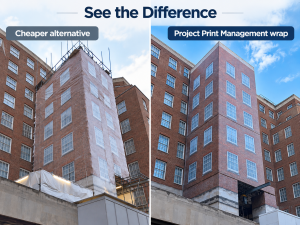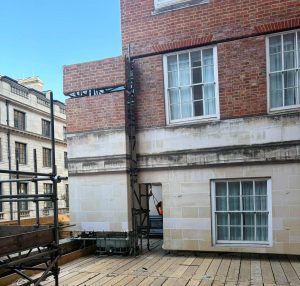
When historic buildings undergo restoration, maintaining their visual presence is just as important as protecting their structure. A carefully designed building wrap print allows essential conservation work to take place while preserving the character of the site.
At Project Print Management, we were proud to deliver Phase 2 of a building wrap print installation at Fulham Palace in Fulham. This was the second large-scale scaffold wrap we have produced for the Palace, continuing our involvement in supporting the restoration of this important heritage venue.
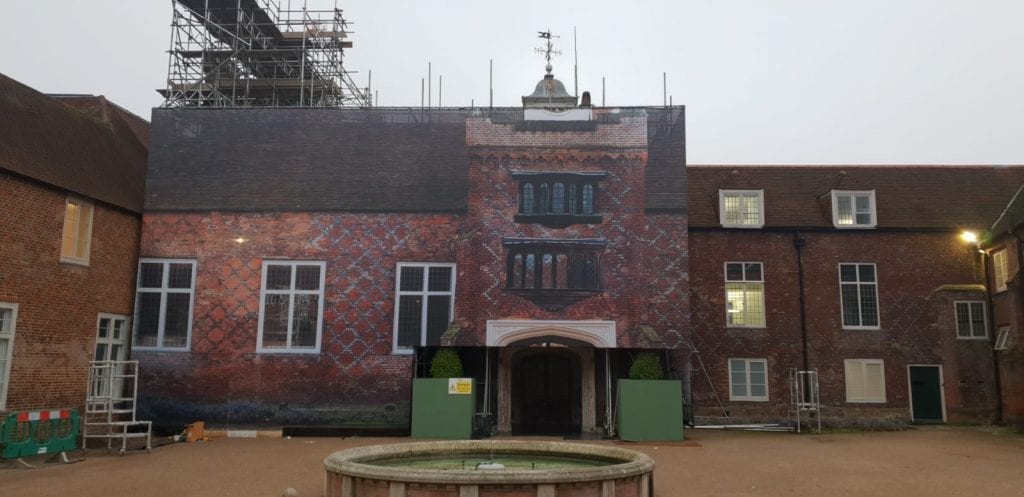
Unlike commercial scaffold advertisements, this decorative wrap contained no advertising. Instead, it faithfully reproduced the façade of the Palace at 1:1 scale, concealing scaffolding and construction works while maintaining the building’s elegant appearance.
What Is a Building Wrap Print?
A building wrap print is a high-resolution photograph or illustration digitally printed onto mesh PVC material. It is commonly referred to as:
-
A scaffold shroud
-
A scaffold wrap
-
A scaffold enclosure
-
A decorative building wrap
While some building wraps incorporate advertising graphics, others — particularly those used on historic sites — are purely decorative. At Fulham Palace, the goal was not commercial promotion, but visual continuity.
The wrap was printed at true 1:1 scale of the existing façade, meaning the architectural features were reproduced in proportion to the real building behind it.
Why Fulham Palace Required a Decorative Building Wrap
Fulham Palace is a historic site regularly used for:
-
Weddings
-
Private parties
-
Corporate events
-
Public gatherings
When restoration and renovation works are underway, scaffolding can significantly impact the visual appeal of the venue. For an event space, this presents a challenge.
By installing a decorative building wrap print:
-
Unsightly scaffolding is concealed
-
Construction workers and equipment are screened
-
The Palace retains its grandeur
-
Event photography remains unaffected
-
The visitor experience is preserved
This approach mitigates the visual disruption caused by essential conservation work.
The Importance of Heritage Sensitivity
Across Europe, decorative building wraps are frequently used on historic landmarks undergoing restoration. In cities such as Paris, Rome and Vienna, it is common to see scaffold wraps reproducing ornate façades while building works are carried out behind them.
In some cases, advertising revenue from these wraps contributes towards refurbishment costs and offsets installation expenses.
In the UK, however, planning authorities often take a more cautious approach to incorporating advertising onto decorative building wraps, particularly on listed buildings or heritage sites.
As a result, projects like Fulham Palace tend to focus on architectural replication rather than commercial messaging.
Phase 2 at Fulham Palace
This project marked the second phase of building wrap print installation at Fulham Palace. Working on a repeat commission demonstrates the effectiveness of the solution during the first phase of works.
The objective remained consistent:
-
Replicate the existing façade accurately
-
Maintain architectural scale and detail
-
Ensure the wrap blended seamlessly with surrounding elevations
-
Deliver a visually convincing result from multiple viewing angles
Because the Palace remains operational for events during renovation, maintaining aesthetic integrity was paramount.
The Art of Making a Building Wrap Print Look Right
Producing a convincing building wrap print is far more complex than simply photographing a façade and enlarging it.
In fact, getting the design right is often the most technically demanding part of the entire project.
Scale and Proportion
The print must be reproduced at precise scale. Even minor distortion can make windows appear misaligned or architectural details look incorrect once installed.
At Fulham Palace, the wrap was produced at true 1:1 scale. This required:
-
Accurate site measurements
-
High-resolution photography
-
Careful digital mapping
-
Alignment with scaffold structure
When installed, the printed architectural features had to align visually with adjacent uncovered sections of the building.
Colour Accuracy
Colour matching is equally critical. Historic buildings often feature subtle tonal variations caused by age, weathering and material texture.
If colours are too saturated or too flat, the illusion fails.
We carefully adjusted tones to ensure the printed façade matched the surrounding brickwork and stonework under natural daylight conditions.
Lighting must also be considered. A building wrap print may look different depending on:
-
Direct sunlight
-
Overcast skies
-
Evening event lighting
Balancing colour to perform well in all conditions is part of the craft.
Perspective and Viewing Angles
Perhaps the most challenging element of decorative scaffold wrap design is perspective.
An image that looks perfect head-on at 90 degrees may appear distorted when viewed from 45 degrees or from street level.
Features such as:
-
Flag poles
-
Exterior lighting
-
Projecting architectural elements
can appear unnatural if perspective is not carefully adjusted.
It is not simply about mathematical correctness — it is about what looks right once installed.
Once the building wrap print is in place, the real structure behind it is hidden. There is no opportunity to visually compare and correct.
This makes pre-installation visualisation and proofing essential.
Technical Production of the Building Wrap Print
The wrap was digitally printed onto durable mesh PVC material. Mesh is typically used for scaffold enclosures because:
-
It allows wind to pass through
-
It reduces load on scaffold structures
-
It remains lightweight yet strong
-
It provides high-quality print clarity at distance
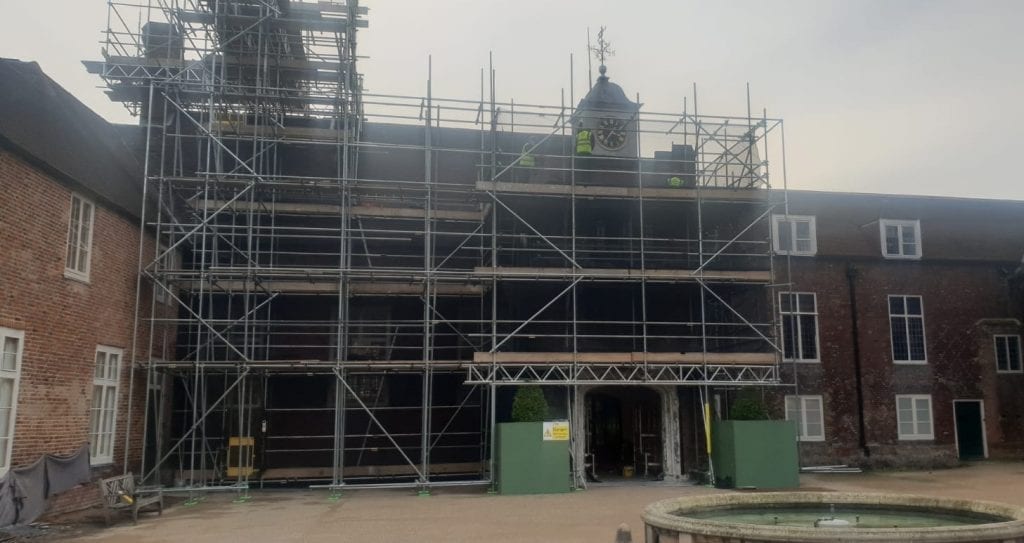
Each section was fabricated to fit the scaffold elevations precisely. Reinforced edges and fixing points ensured secure installation and long-term stability.
Large-format digital printing technology allows us to reproduce fine architectural details, including brick textures, window frames and decorative stonework.
Installation and Structural Considerations
Building wrap print installations require coordination between:
-
Scaffold contractors
-
Structural engineers
-
Print production teams
-
Installation specialists
Wind loading calculations are often required, particularly on larger elevations.
The wrap must be tensioned correctly to:
-
Prevent sagging
-
Avoid distortion of printed imagery
-
Ensure long-term durability
Careful alignment during installation ensures that windows, columns and cornices appear straight and proportional.
Maintaining Visual Integrity During Restoration
For a venue like Fulham Palace, maintaining visual appeal during restoration is essential.
Weddings and corporate events rely heavily on:
-
Photographic backdrops
-
First impressions
-
Architectural character
A decorative building wrap print ensures that event guests experience the beauty of the Palace, even while restoration is ongoing behind the scenes.
Without such a solution, scaffolding could detract from the venue’s atmosphere and impact booking appeal.
Decorative Building Wraps Across Europe
Throughout Europe, large-scale scaffold wraps are widely accepted as part of heritage restoration strategy.
In many cases:
-
Advertising revenue contributes to conservation budgets
-
Local authorities support creative façade replication
-
Building wraps become part of the urban landscape
In the UK, regulations can be stricter regarding advertising content on listed buildings. As a result, purely decorative building wrap prints — such as the one at Fulham Palace — are often the preferred approach.
They preserve heritage aesthetics while complying with planning guidance.
Long-Term Benefits of a Building Wrap Print
A professionally produced building wrap print offers several benefits:
-
Conceals scaffolding
-
Maintains heritage character
-
Reduces negative visual i
impact
-
Supports event continuity
-
Protects site reputation
-
Enhances visitor experience
For historic venues operating during restoration, this solution is both practical and commercially sensible.
Why Experience Matters
Delivering a convincing decorative building wrap requires more than printing capability. It demands:
-
Architectural understanding
-
Perspective correction expertise
-
Colour management knowledge
-
Structural awareness
-
Precise installation
At Project Print Management, we bring years of experience in large-format building wraps and scaffold enclosures across London and the UK.
Our involvement in multiple phases at Fulham Palace reflects our commitment to quality and heritage sensitivity.
The Phase 2 building wrap print at Fulham Palace demonstrates how digital printing can protect a building’s visual identity during restoration.
By reproducing the façade at true 1:1 scale, we were able to conceal scaffolding while maintaining the Palace’s elegant appearance for weddings, corporate events and public visitors.
Decorative building wrap print is both a technical and artistic discipline. Achieving accurate scale, colour balance and perspective ensures the illusion works from every angle.
For heritage venues undergoing renovation, a professionally designed scaffold wrap offers a practical solution that safeguards both structure and reputation.
If you are planning restoration works and wish to maintain visual continuity, Project Print Management can provide expert design, print and installation services tailored to your site.
For more information on some of our other projects visit our building wraps page or our blog.