Banner Scaffold Advertising: Harvey Nichols Bristol Construction Project
Banner scaffold advertising: When a building is undergoing construction or refurbishment, the surrounding scaffolding can often become an unavoidable part of the streetscape. For major retail brands, this can present an opportunity to turn otherwise unused scaffold space into valuable advertising.
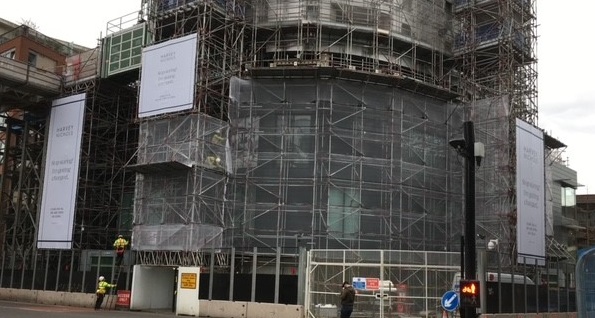
That was the approach taken by Harvey Nichols during the construction work at its Bristol store, where the retailer used banner scaffold advertising to maintain a strong visual presence while work was taking place.
The original plan was to install a much larger building wrap advertisement across the construction site. However, planning permission for the proposed large-scale building wrap was not granted. The project therefore moved towards a more practical solution: three smaller scaffold advertising banners positioned within dedicated scaffold picture frames.
This demonstrates an important consideration for businesses looking to use construction sites for advertising. Scaffold banner advertising can sometimes provide a more practical alternative to a full building wrap, particularly where planning restrictions limit the size or positioning of advertising.

Creating an Advertising Solution Around Planning Restrictions
Large building wraps can create a dramatic advertising presence, but they can also be subject to planning restrictions, particularly in prominent town and city-centre locations.
For the Harvey Nichols Bristol project, the original larger advertising concept could not proceed as planned. Instead, the project was redesigned around three individual banner scaffold advertising displays.
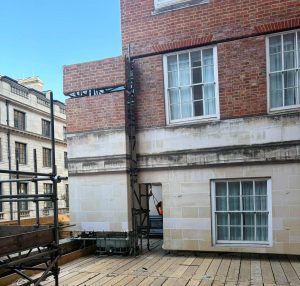
Rather than covering the entire building, the banners were installed within specially constructed scaffold picture frames. This provided a strong advertising presence while reducing the overall scale of the display.
For brands considering advertising on scaffolding, this type of approach can offer greater flexibility. The size, number and positioning of individual banners can potentially be adapted to suit the available scaffold structure and the requirements of the site.
However, planning requirements vary from location to location, so businesses should always establish what is permitted before committing to artwork production or installation.
Banner Scaffold Advertising Materials
There are several materials that can be considered when producing scaffold advertising banners, depending on the application, location and requirements of the project.
Project Print Management can produce scaffold banners using materials including:
- Solid PVC banners for strong, opaque graphics
- Mesh PVC banners where airflow and wind loading are important considerations
- Backlit PVC where illumination is required
Mesh PVC is particularly useful for larger scaffold applications because its perforated construction allows a degree of airflow through the printed graphic. The exact material specification should always be determined according to the size, location, scaffold design and structural requirements of the installation.
Backlit advertising can create a highly visible display, particularly at night, although illuminated advertising can introduce additional planning considerations. For this reason, it is important to establish whether the proposed advertising format is acceptable before production begins.
Working with the Scaffold Contractor
Project Print Management was contracted to deliver the Harvey Nichols Bristol scaffold advertising project by scaffold contractor Lyndon SGB.
Because the project was operating to a very tight programme, it was important that the advertising production process started as quickly as possible.
Our surveyor attended the site and worked with Lyndon SGB’s management team to agree the proposed dimensions and design requirements for the scaffold picture frames.
This meant that production of the printed PVC banners could begin while the picture frames themselves were still being completed.
Although this approach helped the project meet its demanding schedule, it is not normally the preferred production method.
Scaffold structures can sometimes change during construction because of practical limitations, access requirements or alterations to the main scaffold. Any change in dimensions between the initial survey and completion of the frame can potentially affect the finished banner.
For this reason, accurate measurements and close communication between the scaffold contractor, advertising client and print specialist are particularly important.
Rapid Production and Installation for Banner scaffold advertising
The tight programme meant that the Harvey Nichols project had to move from initial survey through production and installation in a very short period.
Following the site survey and agreement of the dimensions, the banners went into production while the scaffold picture frames were being completed.
Once the frames were ready, Project Print Management’s specialist rope access installation team attended site and installed the three banner scaffold advertising displays.
The banners were tensioned and secured using a bungee-core lacing system around the picture frames. This provides a practical method of securing the graphics while helping to maintain tension across the printed surface.
From the initial survey through to completion, the entire project was delivered in just eight days.
For construction projects operating under demanding programmes, the ability to coordinate survey, artwork, production and installation quickly can be critical.
Eclipse Tower and the Surrounding Construction Work
The advertising installation formed part of a wider construction and refurbishment environment surrounding the Harvey Nichols store.
Above the store was Eclipse Tower, a 14-storey luxury apartment development, where refurbishment work included the removal of existing external cladding.
The project took place in the wider context of heightened scrutiny of building cladding and façade systems following the Grenfell Tower tragedy in London in 2017. The tragedy led to major changes in the way building safety, external wall systems and construction materials are considered across the UK.
For projects involving occupied buildings, retail premises or busy city-centre locations, construction work can have a significant visual impact. Scaffold advertising can provide a way for businesses and brands to make productive use of selected areas of the temporary structure while refurbishment work is underway.
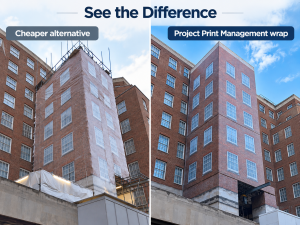
Banner scaffold advertising vs Full Building Wraps
A full building wrap can create an impressive advertising installation, particularly when the entire façade is available for a large-scale graphic.
However, not every project will be suitable for a full wrap.
Planning restrictions, the location of the building, the surrounding streetscape and the proposed size of the advertisement can all influence what may be permitted.
Banner scaffold advertising provides an alternative approach. Rather than attempting to cover an entire building, individual advertising banners can be installed within specific areas of the scaffold.
This can make it possible to create a high-impact advertising campaign without requiring the same scale of coverage as a complete building wrap.
The best solution will depend on the individual project, and early discussions with the relevant planning authority are strongly recommended.
Always Check Planning Requirements First
If you are considering advertising on a scaffold structure, one of the most important steps is to speak to the local planning authority before proceeding.
Advertising on scaffolding can be subject to planning controls, and requirements can vary depending on the location, size, illumination, duration and visual impact of the proposed installation.
Do not assume that because a scaffold is already in place, advertising can automatically be added to it.
Obtaining advice at an early stage can help establish whether a full building wrap, individual scaffold banners or another advertising format is likely to be appropriate.
It can also prevent unnecessary artwork, production and installation costs if the proposed advertising format cannot be approved.
Making Banner scaffold advertising Work Harder for Your Brand
The Harvey Nichols Bristol project demonstrates how banner scaffold advertising can provide an effective alternative when a larger building wrap advertisement is not possible.
By combining bespoke scaffold picture frames, digitally printed PVC banners and specialist rope access installation, Project Print Management delivered three high-impact advertising displays within a demanding eight-day programme.
For retailers, developers, property owners and brands, construction sites do not necessarily have to become an unwanted visual distraction. With the right planning and design, selected scaffold areas can become valuable advertising space.
Whether you are considering scaffold advertising banners, PVC scaffold banners, construction site advertising or a larger building wrap, Project Print Management can help develop a solution around your project requirements.
The key is to involve your print and installation specialist early, work closely with the scaffold contractor and, most importantly, establish the planning requirements before committing to the final advertising format.
www.bristolpost.co.uk/news/bristol-news/tower-above-harvey-nichols-finally-3770788
For more information please contact us. For our latest projects please visit our blog page.