
At the start of every new year, we take time to reflect on the projects that have defined the previous seasons. For Project Print Management, some of the most ambitious and technically demanding installations have been large-scale building wraps.
Delivering the largest building wrap projects requires far more than simply printing big graphics. It demands engineering expertise, careful planning, structural calculations, council compliance and flawless installation. Over the past 25 years in the print and large-format graphics industry, we have seen ambitious concepts succeed — and others fall away due to feasibility, safety or budget constraints.
In this article, we look back at some of our most significant building wrap installations and explain what it really takes to deliver large-scale mesh and façade graphics safely and professionally.
Why Building Wraps Continue to Grow in Popularity
Covering unattractive scaffolding or ageing façades is not a new idea. However, the scale, quality and ambition of building wraps have increased dramatically in recent years.
A well-designed building wrap can:
Conceal scaffolding during refurbishment
Transform a tired façade
Deliver impactful advertising
Maintain heritage aesthetics during restoration
Create trompe l’oeil architectural illusions
Enhance brand presence on landmark buildings
When executed properly, large-scale mesh wraps blend seamlessly into their surroundings — or make a bold visual statement, depending on the objective.
But as size increases, so does complexity.
Size Comes at a Cost — Literally and Logistically
With building wraps, scale is everything. Larger projects involve:
Increased material costs
Specialist sub-frame structures
Wind load engineering
Council advertising consent
Structural feasibility assessments
Traffic and pedestrian management
Ongoing maintenance planning
Not every ambitious concept progresses beyond the planning stage. Over the years, we have seen projects paused or cancelled due to:
Budget limitations
Advertising consent refusal
Structural concerns
Excessive wind loading risk
Safety is always the overriding priority. No visual impact is worth compromising structural integrity.
Engineering and Wind Loading Calculations for Largest building wrap
Large building wraps behave like sails when exposed to wind. The greater the surface area, the higher the potential wind load forces.
For this reason, qualified structural engineers must calculate:
Wind pressure
Fixing requirements
Load distribution
Stress tolerances
Building attachment limitations
A professional building wrap company will always provide wind-loading calculations where required.
At Project Print Management, we work alongside structural engineers to ensure every installation meets safety regulations. When necessary, we provide detailed load calculations and structural documentation for client and council approval.
Full Project Management from Start to Finish
Large-scale building wrap installations require coordinated management. We offer a complete service including:
Initial consultation
Site survey
Structural feasibility review
Design development
Print production
Sub-frame engineering
Installation
Maintenance packages
This turnkey approach provides clients with peace of mind, knowing every element is managed professionally.
Our Largest Building Wrap Projects
Below are some of the most significant large building wrap projects we have delivered in recent years.
Everton Football Club Stadium – 3700m²
Our largest building wrap to date covered an impressive 3,700 square metres of digitally printed mesh installed around the exterior of Everton’s stadium in Liverpool.
Due to the sheer scale and age of the stadium, a specialist engineering company was appointed to design and install the structural sub-frame. This was not a temporary scaffold cover — it was a permanent installation, requiring long-term structural consideration.
Key Challenges
Historic stadium structure
Large uninterrupted elevations
Permanent installation requirements
Wind loading calculations
Access and installation logistics
At 3,700m², the project required extensive coordination between engineers, installers and stadium management. The digitally printed mesh allowed wind to pass through while maintaining high visual impact.
The result was a landmark installation that combined engineering precision with large-format print expertise.

Harley Street Project – 2035m² Across Nine Buildings
Our second largest building wrap project totalled 2,035m² and spanned nine buildings across four separate installations in Harley Street, London.
This project showcased our speciality in trompe l’oeil building wraps — printed graphics designed to replicate architectural details so convincingly that passers-by barely notice the building is wrapped.
Why Trompe l’Oeil Works
Trompe l’oeil (meaning “deceive the eye”) wraps are particularly effective in sensitive urban areas. They:
Preserve the aesthetic of the streetscape
Conceal scaffolding
Maintain a sense of heritage
Avoid overly commercial appearance
When executed properly, pedestrians can walk past without realising they are viewing printed mesh rather than the original façade — which is often exactly the intention.
Delivering this level of realism requires precise photography, colour matching and large-format print accuracy.
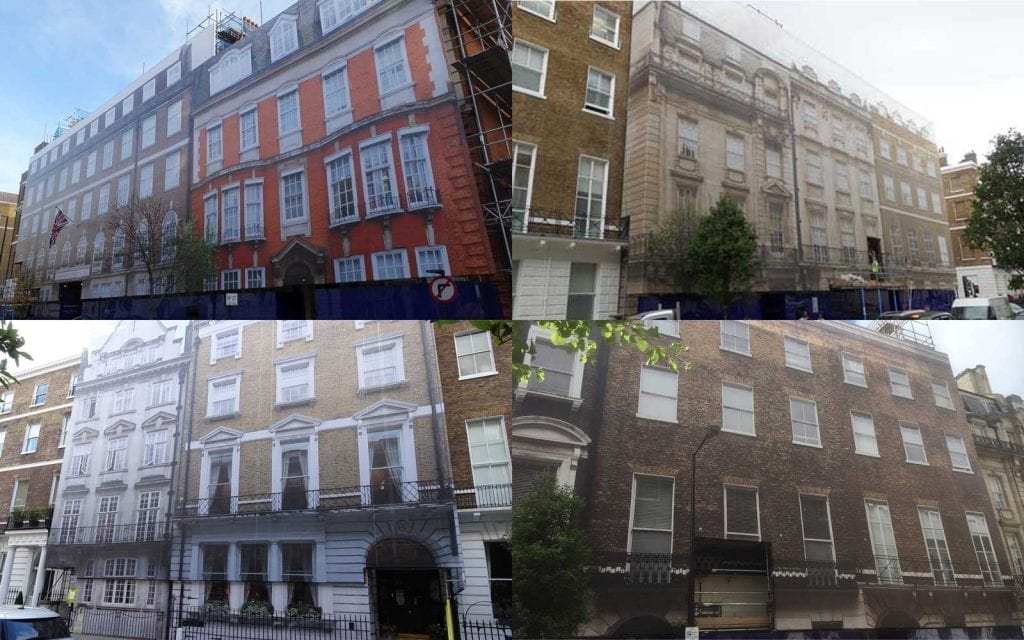
Harley Street, London building wraps
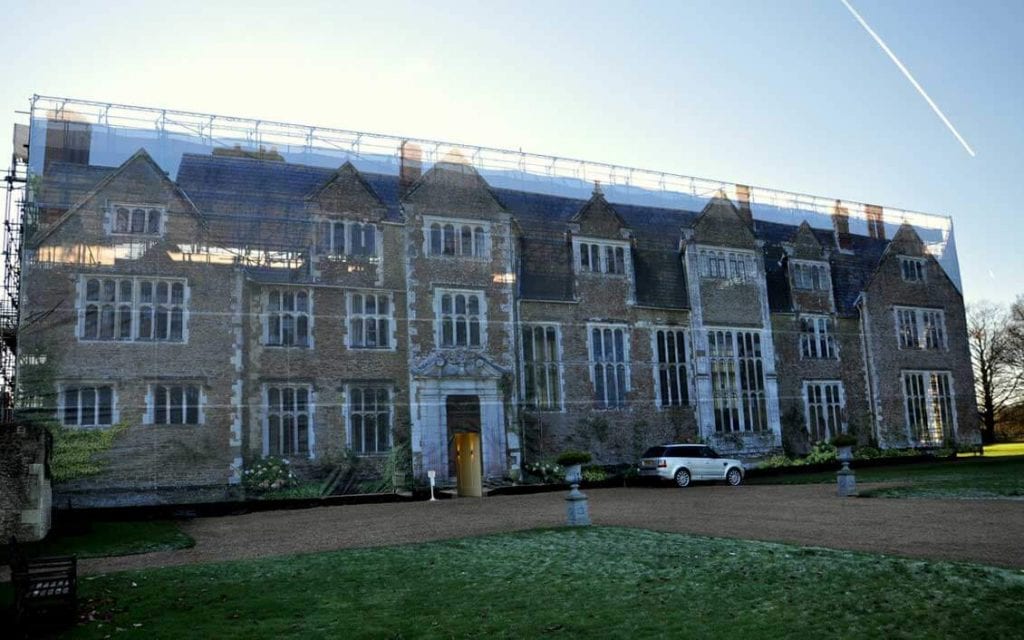
Loseley House – 1184m²
Loseley House, located near Guildford, provided our third largest building wrap installation, totalling 1,184m².
This was particularly special for us, as the site is just one mile from our office. Working on a prominent local landmark added both pride and responsibility.
Project Highlights
Heritage-sensitive environment
Large single mesh sections
Detailed photographic reproduction
Careful structural integration
One section of the wrap measured 880m² — close to the practical limit for a single piece of mesh. It weighed approximately 350kg, requiring careful lifting and installation planning.
Producing and installing mesh of this size demands precise welding, reinforcement and edge finishing to ensure durability and safe tensioning.
Wigmore Street, London – 1000m² Across Seven Elevations
Our Wigmore Street project in Wigmore Street, London, covered 1,000m² across seven elevations using five separate mesh banners.
The complexity of this installation lay not only in its scale but in its detailing.
Unique Challenges
Complex sub-frame design
Hidden fixings requirement
Multiple elevations
Retained building fascia
Weekly laser surveying access
The building façade was being retained and required weekly laser surveys. To accommodate this, several pre-installed holes were carefully incorporated into the mesh wrap design. The wrap had to be positioned with absolute precision to ensure survey access points aligned correctly.
Additionally, the sub-frame was engineered so that no visible fixings disrupted the clean visual finish.
This level of detail demonstrates that large building wrap projects are as much about precision as they are about scale.

Wigmore Street, London scaffold wrap
Material Considerations for Large Building Wraps
Most large building wraps are produced using:
Digitally printed mesh PVC
Solid PVC banners (where wind load permits)
Reinforced edges and eyelets
Shock cord tensioning systems
Mesh is typically preferred for large installations because it reduces wind resistance while still delivering strong image clarity from a distance.
Modern super-wide format printers allow us to print up to five metres wide. Larger sections are welded together to create expansive continuous graphics.
Planning and Council Approval Large building wrap installations often require:
Advertising consent
Planning permission
Structural approval
Neighbour consultation
Each borough or council may have different requirements. Early engagement and thorough documentation are essential to avoid delays.
Our experience working across London and the UK enables us to guide clients through this process efficiently.
Maintenance and Longevity for Largest building wrap
Large-scale building wraps are exposed to:
Wind
Rain
UV light
Pollution
Urban debris
We offer maintenance packages to ensure:
Tension remains correct
Fixings are secure
Graphics remain clean
Damage is addressed promptly
Proactive maintenance protects both safety and visual impact.
What Defines the “Largest Building Wrap”?
While square metre coverage is one metric, the true measure of a large building wrap project includes:
Engineering complexity
Installation logistics
Structural sensitivity
Heritage considerations
Graphic realism
Long-term durability
A 1,000m² installation on a complex heritage building may require more technical expertise than a larger but simpler scaffold wrap.
At Project Print Management, we approach every project — regardless of size — with the same commitment to safety and quality.
Why Experience Matters in Large Building Wrap Projects
After 25 years in the industry, we understand that ambitious designs must be matched by structural reality.
We work collaboratively with:
Structural engineers
Scaffold companies
Local authorities
Architects
Main contractors
This ensures feasibility is assessed early and risks are mitigated before production begins.
Looking Ahead for our next Largest building wrap
As printing technology continues to advance, and as developers seek innovative ways to conceal construction or create visual impact, demand for large building wraps will continue to grow.
However, the fundamentals remain unchanged:
Safety first
Engineering compliance
Professional installation
High-quality print production
From 3,700m² stadium wraps in Liverpool to intricate trompe l’oeil installations in central London, we are proud of the scale and ambition of the projects we have delivered.
If you are considering a large building wrap — whether for branding, restoration concealment or architectural enhancement — our team can guide you through design, engineering, print and installation with confidence.
Because when it comes to delivering the largest building wrap projects, experience, precision and safety make all the difference.