Banner Frame System: What Works, What Doesn’t, and Why Installation Matters
When it comes to advertising on construction site hoardings, cost, speed, and flexibility are often the deciding factors. One of the most popular solutions is the banner frame system, which allows a digitally printed PVC banner to be tensioned neatly onto an existing hoarding structure. When installed correctly and on a well-built hoarding, this system can work effectively and provide good visual impact.
However, as with many things in construction and print installation, the final result is only as good as the structure it is fixed to. At Project Print Management, we’ve installed countless banner frame systems across London and the South East, and we’ve learned—sometimes the hard way—that hoarding quality plays a critical role in how successful the finished banner looks.
This blog explores the realities of using banner frame systems on site hoardings, the challenges involved, best practice guidance, and lessons learned from a particularly difficult installation in Putney, London.
What Is a Banner Frame System?
A banner frame system is an aluminium framing solution designed to hold and tension PVC banners. The frame is fixed directly to a hoarding or wall, and the banner is secured into the frame using a tensioning profile, often referred to as a “snap-in” or “keder” system.
The key advantages of a banner frame system include:
-
Lower cost compared to printed aluminium composite panels
-
Lightweight materials
-
Faster production and installation
-
Easy banner replacement if artwork changes
-
Flexibility to work around doors, gates, and tight areas
For short- to medium-term advertising on building sites, it’s an attractive option—on paper.
Why Banner Frame Systems Are Popular on Hoardings
Construction site hoardings are frequently used for branding, marketing, and wayfinding. Developers and contractors want to make sites look professional while promoting their company or project.
Compared with printed aluminium composite panels, PVC banners installed within a banner frame system are:
-
More cost-effective upfront
-
Quicker to produce
-
Easier to transport
-
Suitable for temporary applications
For many clients, particularly on projects with tight budgets or short timescales, this makes banner frame systems an appealing choice.
However, there is an important caveat.
The Problem: Hoardings Are Rarely Straight
The biggest challenge with installing a banner frame system on a construction site hoarding is that most hoardings are not straight, square, or parallel—even if they look fine when first installed.
Hoardings are usually constructed from:
-
Timber posts
-
18mm plywood or OSB boards
-
Temporary fixings
-
Uneven ground conditions
Over time, these structures move.
Weather Is the Biggest Enemy
Wooden hoardings are particularly vulnerable to weather. Rainwater is absorbed into the boards, causing them to expand. During dry spells, they contract again. Over weeks or months, this constant movement leads to:
-
Bowing
-
Buckling
-
Twisting
-
Uneven surfaces
Even a few millimetres of movement across a large hoarding run can have a significant visual impact once a banner is tensioned across it.
Why Rippling Happens in PVC Banners
PVC banners rely on even tension to look flat and professional. When a banner frame system is installed onto an uneven hoarding, several issues occur:
-
The frame follows the shape of the hoarding
-
Tension becomes inconsistent
-
The banner pulls tighter in some areas than others
-
Ripples, waves, and twists become visible
No amount of pulling or re-tensioning can fully correct this if the underlying structure is badly distorted.
This is one of the main reasons PVC banners, while cost-effective, rarely achieve the same premium finish as rigid printed panels.
Best Practice: Building Hoardings Correctly
A common assumption is that hoardings are straight when installed. In reality, even new hoardings can develop issues within weeks if not constructed correctly.
The Importance of Expansion Gaps
One of the most important pieces of good practice is leaving a 10mm expansion gap between each timber panel. Typically, hoardings are built using 18mm plywood or OSB boards fixed edge-to-edge.
Without expansion gaps:
-
Boards absorb moisture
-
They swell
-
Pressure builds
-
The hoarding buckles
By leaving a small gap between boards, the timber can expand and contract naturally without distorting the overall structure.
Unfortunately, this detail is often overlooked—especially on fast-track projects.
Advertising Banner Frame System Installation in Putney
A good example of these challenges came from an installation Project Print Management carried out in Putney, London, over the Christmas period.
The client wanted a PVC banner installed using a banner frame system, fixed directly onto an existing site hoarding. From the outset, we flagged potential issues with the hoarding’s condition and explained that the finish might not be perfect.
The client understood the risks and chose to proceed, as this solution best suited their budget and time-frame.
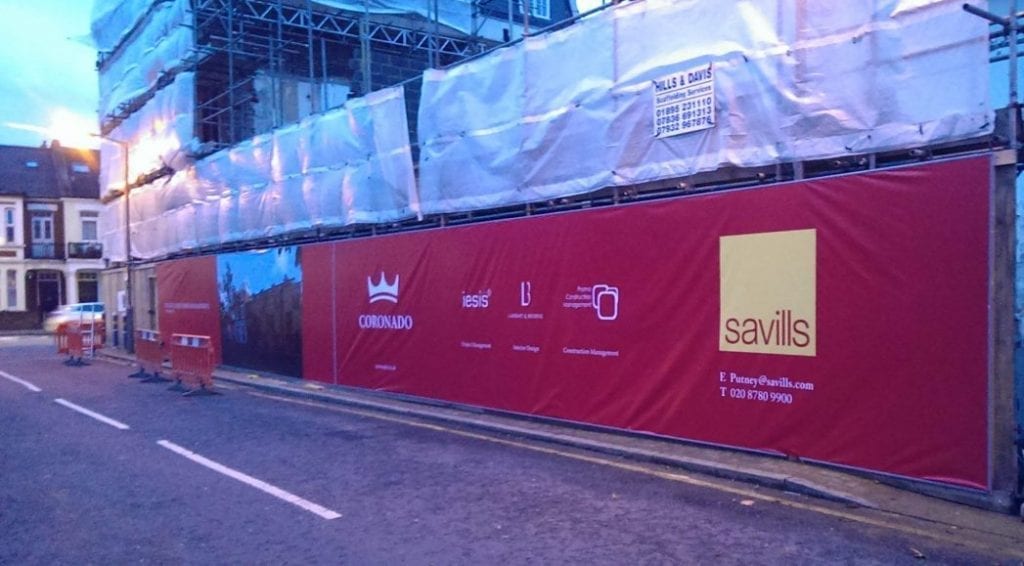
The Installation Process
For this project, we:
-
Supplied and installed an aluminium banner frame system onto the hoarding
-
Digitally printed the PVC flex-face banner at high resolution
-
Used a snap-in tension profile that allows approximately 20mm of banner tension
-
Worked carefully around doors, frames, and tight site access points
One of the advantages of this banner frame system is its small channel profile, which makes it ideal for complex hoardings with multiple openings.
The Challenge: Extreme Weather Conditions
This installation followed what was reported as the wettest winter in 250 years. By the time we arrived on site:
-
The hoarding had visibly buckled
-
Panels were twisted along their length
-
The surface was far from flat
Despite careful measuring, precise frame installation, and repeated re-tensioning of the banner, rippling remained visible.
We spent a significant amount of time attempting to reduce these distortions, but the underlying hoarding structure simply would not allow for a perfectly smooth finish.
An Honest Outcome
As professionals, we aim for the best possible result on every project. In this case, while the banner frame system was installed correctly and securely, we were ultimately disappointed with the final appearance.
Not because of poor materials or workmanship—but because the hoarding itself was beyond correction.
This experience reinforces an important message:
A banner frame system can only perform as well as the structure it is fixed to.
Banner Frame System vs Aluminium Composite Panels
It’s worth comparing banner frame systems with printed aluminium composite panels to understand when each solution is most appropriate.
Banner Frame System
Pros
-
Lower initial cost
-
Lightweight
-
Easy to update graphics
-
Suitable for short-term projects
Cons
-
Relies heavily on hoarding quality
-
Susceptible to rippling
-
Less premium finish
Aluminium Composite Panels
Pros
-
Rigid and flat
-
Consistent, high-end appearance
-
Less affected by hoarding movement
-
Longer lifespan
Cons
-
Higher upfront cost
-
Less flexible for artwork changes
For long-term or highly visible sites, rigid panels often provide better value in the long run.
When a Banner Frame System Still Makes Sense
Despite the challenges, banner frame systems are still a valid solution in many situations:
-
Temporary hoardings with good construction quality
-
Short-term advertising campaigns
-
Projects with limited budgets
-
Sites where graphics may need frequent updates
The key is setting realistic expectations and ensuring the hoarding structure is suitable before committing.
Our Approach at Project Print Management
At Project Print Management, we believe in transparency. If a site or hoarding presents risks to visual quality, we’ll explain them clearly before work begins.
Our role isn’t just to print and install—it’s to advise, guide, and help clients choose the right solution for their project.
Where possible, we’ll suggest:
-
Hoarding improvements
-
Alternative materials
-
Hybrid solutions
-
Design approaches that minimise visible distortion
Sometimes, the best advice is knowing when a banner frame system isn’t the right choice.
Final Thoughts
A banner frame system can be an effective and economical way to display advertising on construction site hoardings—but only when the structure beneath it is built correctly and maintained well.
As the Putney installation demonstrated, even the best materials and experienced installers can’t overcome severely buckled hoardings caused by weather and poor construction practice.
If you’re considering a banner frame system for your site, early planning, proper hoarding construction, and honest advice are essential to achieving the best possible result.
For expert guidance on banner frame systems, hoarding graphics, or alternative solutions, contact Project Print Management. We’ll help you make the right choice—before problems arise.
For more information on our latest project please visit our blog.