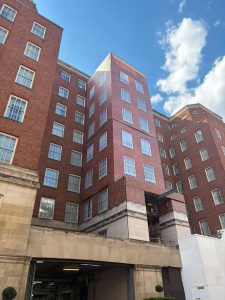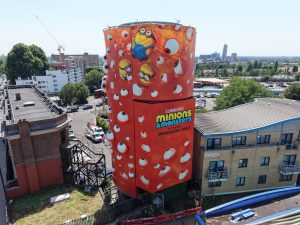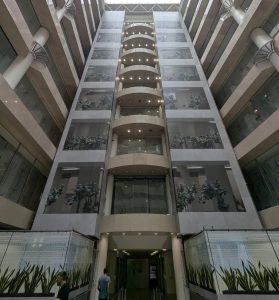

A facade wrap is often associated with large-scale building exteriors, concealing scaffolding during renovation works. However, its applications go far beyond city centre construction projects. In the right context, a façade wrap can transform interiors, recreate lost architectural detail and help heritage organisations tell a compelling story.
This recent project for Painshill Park demonstrates how creative print solutions can be delivered quickly and cost-effectively, even within historically sensitive environments. Working inside the restored Temple of Bacchus, Project Print Management was commissioned to temporarily conceal unfinished internal construction and recreate the decorative grandeur of the original 18th-century design.
The goal was not simply to cover raw surfaces — it was to help potential investors and sponsors visualise what the completed temple will look like once the remaining £500,000 fundraising target is achieved.
What Is a Facade Wrap?
A façade wrap is a large-format digitally printed surface applied to walls, ceilings or structural frameworks to replicate architectural finishes or decorative detail. While commonly used externally on scaffolding, it can also be tensioned internally across timber frames or aluminium structures to create immersive environments.
This flexibility makes façade wraps particularly valuable for:
-
Heritage restoration projects
-
Temporary exhibitions
-
Fundraising showcases
-
Event installations
-
Interior transformation
At Painshill Park, the façade wrap solution enabled the estate team to present a finished, historically inspired interior without committing to permanent construction works at this stage.
The Temple of Bacchus at Painshill Park
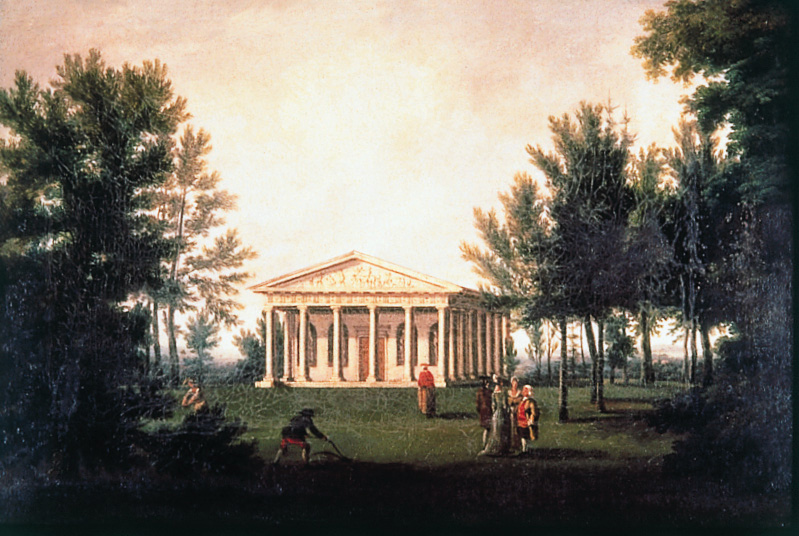
Painshill Park is an 18th-century landscaped garden created by the Honourable Charles Hamilton. Inspired by his Grand Tours across Europe, Hamilton designed a series of follies and classical structures throughout the park.
One of these was the Temple of Bacchus — dedicated to Bacchus, the Roman god of agriculture, wine and fertility, and son of Jupiter.
The original temple, completed in 1762, was constructed using wood, plaster and papier-mâché. It housed Hamilton’s collection of antiques, including a 2.13-metre marble statue of Bacchus and twelve marble busts of Roman emperors. The contents were sold in 1797, and the structure itself did not survive beyond the 1950s.
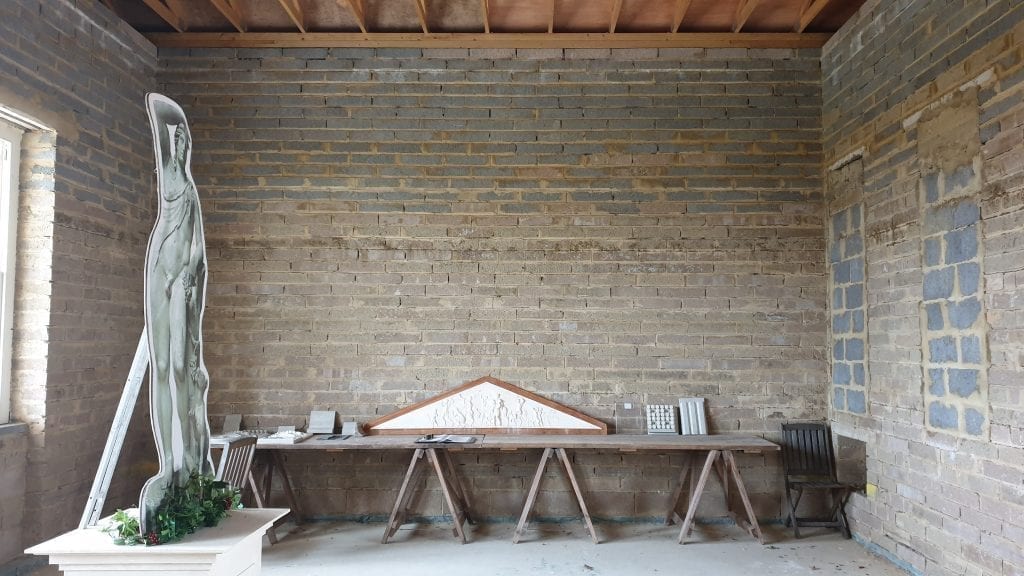
The recent restoration has brought the external structure back to life to a high standard. However, internally the newly constructed space remained unfinished — plain walls and exposed building materials offering little sense of the historical grandeur once present.
To support ongoing fundraising efforts, the estate team sought a way to present a convincing visual impression of the completed interior.
The Challenge: Concealing Unfinished Work
Externally, the temple now appears elegant and complete. Internally, however, visitors could clearly see the raw construction elements.
The brief was to:
-
Conceal unfinished internal walls
-
Recreate an 18th-century neoclassical ceiling
-
Install replica Roman busts and statues
-
Deliver the solution quickly
-
Ensure it remained temporary and removable
A façade wrap solution offered the ideal balance between visual impact and practicality.

Using a Facade Wrap for the Interior
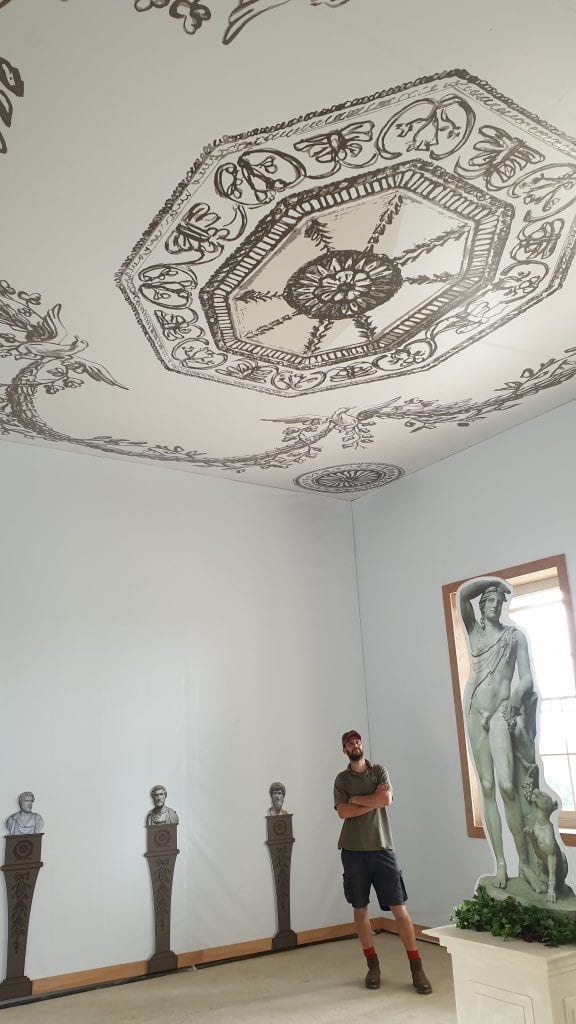
To create a refined internal finish, we installed a timber sub-frame onto which black-backed PVC panels were tensioned.
The walls required a crisp white finish. However, standard PVC can sometimes allow the shadow of battens or framework to show through when backlit. To prevent this, we used black-backed PVC, ensuring the timber supports remained completely invisible behind the surface.
The result was a clean, seamless wall finish that concealed all structural elements.
Recreating the Adam-Style Ceiling with Facade wrap
The ceiling became the centrepiece of the project.
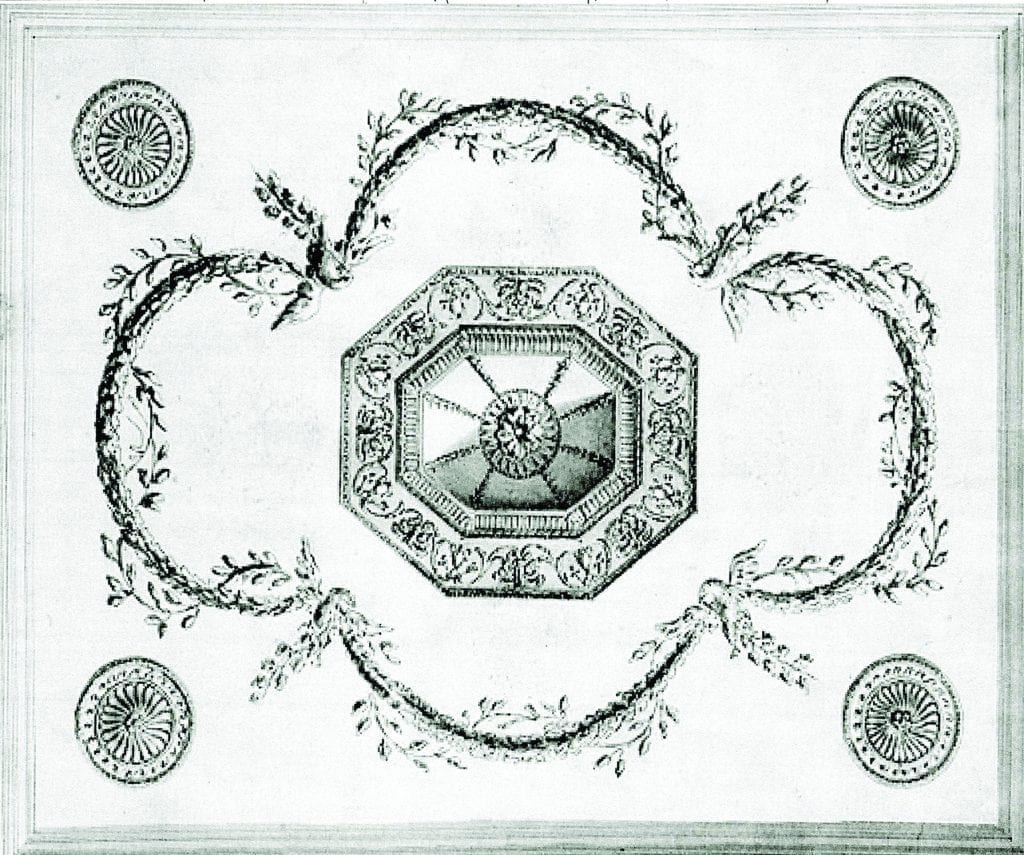
Historical records show that the original temple ceiling was designed in the neoclassical style associated with the Adam brothers. The decorative scheme featured:
-
A rectangular layout
-
A central rosette
-
An octagonal panel with leaves and calyx drops
-
Framing arabesques
-
Festoons of bell flowers entwined with vines
-
Four eagles holding garlands
-
A patera in each corner
An original 1761 drawing, inscribed “Ceiling for the Temple of Bacchus at Cobham,” provided a reference point. However, the drawing itself was not suitable for direct scanning and printing due to its age and quality limitations.
Rather than compromise print clarity, we recreated the entire design as a vector graphic.
Why Vector Recreation Was Essential
Rebuilding the artwork in vector format provided several advantages:
-
Infinite scalability without loss of quality
-
Flexibility to adjust colours
-
Precision in linework
-
Control over decorative balance
-
Accurate reproduction at large scale
The finished ceiling panel measured 6.8 metres by 8.31 metres and was digitally printed in high resolution onto PVC.
Because the panel would hang horizontally, structural support was essential. Rear ties were added at two-metre intervals to prevent sagging and maintain a taut, even surface.
The result is a visually striking ceiling that convincingly evokes 18th-century craftsmanship while remaining entirely removable.
Busts of Caesars and Classical Statues
To further enhance the immersive experience, we produced twelve replica Roman busts mounted on pedestals.
These included figures historically associated with the temple, such as:
-
Julius Caesar
-
Augustus
-
Hadrian
-
Trajan
-
Caligula
-
Commodus
Each bust was digitally printed onto 10mm Foamex and profile cut to shape using precision routing technology.
In addition, four full-size classical statues were produced, including references to works such as:
-
Venus de Medici
-
Apollo Belvedere
These were printed onto 10mm Foamex panels and supported with rear standees. To ensure stability within the space, each statue was weighted with concealed concrete blocks.
The result is a dramatic interior setting that helps visitors imagine how the temple would have appeared in 1763.
Balancing Authenticity and Practicality with Facade wrap
A key aspect of this project was balancing historical authenticity with modern production methods.
The façade wrap and replica elements needed to:
-
Respect the architectural integrity of the site
-
Avoid permanent intervention
-
Remain removable without damage
-
Meet safety requirements
-
Be installed efficiently
Using lightweight materials such as PVC and Foamex ensured minimal structural impact while delivering convincing visual results.
Supporting Fundraising Through Visualisation
Heritage restoration projects often rely heavily on donor engagement and sponsorship. It can be difficult to secure funding for work that exists only as plans or sketches.
By installing a façade wrap and immersive interior elements, Painshill Park can now show potential sponsors:
-
The intended ceiling design
-
The arrangement of classical busts
-
The overall atmosphere of the completed temple
This tangible experience significantly strengthens fundraising conversations.
Rather than asking supporters to imagine the finished result, the park can demonstrate it visually.
The Broader Applications of Facade Wrap
This project highlights how façade wrap solutions extend far beyond traditional building wraps.
Applications include:
-
Interior exhibition design
-
Museum installations
-
Retail fit-outs
-
Event staging
-
Themed environments
-
Temporary heritage displays
Because façade wraps are digitally printed and tension-mounted, they can be installed rapidly and removed without permanent structural alteration.
For organisations managing listed buildings or sensitive sites, this flexibility is invaluable.
Speed and Cost Effectiveness of the Facade wrap
Time and budget were important considerations for this project.
Reconstructing traditional plaster mouldings and sculptural details would have required significant investment and extended construction timelines.
Instead, digital production allowed:
-
Rapid artwork recreation
-
Efficient large-format printing
-
Quick on-site installation
-
Lower overall cost
The finished result delivers high visual impact at a fraction of the cost of permanent decorative work.
Preserving Heritage Through Modern Print with Facade wrap
At Project Print Management, we specialise in using large-format print technology to support architectural and heritage projects.
This façade wrap installation at Painshill Park demonstrates how digital printing can:
-
Bridge funding gaps
-
Enhance visitor experience
-
Protect heritage structures
-
Enable creative storytelling
By combining historical research with modern materials and precision production methods, we helped transform an unfinished interior into a compelling visual space.
The façade wrap installation inside the Temple of Bacchus at Painshill Park is a powerful example of how print can support heritage restoration.
By covering unfinished internal construction with tensioned PVC panels, recreating an 18th-century Adam-style ceiling and installing replica Roman busts and statues, we delivered a temporary yet convincing vision of the temple’s future.
For heritage estates, cultural institutions and developers alike, façade wrap solutions offer flexibility, cost efficiency and impressive visual impact.
If you are planning a restoration, exhibition or interior transformation project and need a creative large-format solution, Project Print Management can help you bring your vision to life — quickly, sensitively and effectively.
For more information on facade wraps please visit here, or for our latest print projects please visit our blog.