When historic buildings undergo restoration, scaffolding is essential — but it can significantly alter the appearance of treasured landmarks. A carefully designed construction wrap provides a practical way to protect a building during works while preserving its visual presence within the surrounding townscape.
Project Print Management was commissioned to produce and install a large-scale construction wrap at Fulham Palace during its restoration phase. The aim was clear: conceal the scaffolding, respect the building’s heritage, and create a seamless visual continuation of the façade while conservation work progressed behind the scenes.
This project demonstrates how a professionally engineered building wrap can successfully combine design precision, structural planning, and heritage sensitivity.
A Brief History of Fulham Palace
Fulham Palace is one of west London’s most historically significant buildings. For over 1,300 years, it served as the principal residence of the Bishops of London. Although commonly referred to as a “palace,” it functioned primarily as a manor house with evolving architectural additions reflecting different periods.
The site features:
- Tudor and Georgian architectural elements
- A historic walled garden dating back centuries
- Extensive landscaped grounds
- A rich ecclesiastical history tied to the Diocese of London
Situated close to the River Thames, the building holds both architectural and cultural importance. Any external work undertaken at such a landmark must carefully consider its heritage value and visual identity.
During restoration, maintaining the dignity and character of the building was essential — even while it was temporarily hidden behind scaffolding.
What Is a Construction Wrap?
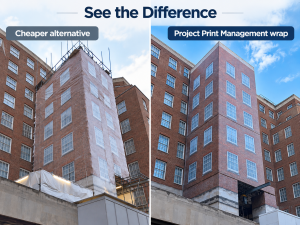
A construction wrap is a life-like image digitally printed onto fabric, mesh, or PVC material and installed onto a specially designed scaffolding sub-frame. Often referred to as a trompe l’oeil building wrap — meaning “deceive the eye” — this technique uses detailed photographic imagery to create an optical illusion.
When executed correctly, it can:
- Replicate the original façade
- Blend into the surrounding environment
- Conceal scaffolding and temporary works
- Maintain architectural continuity
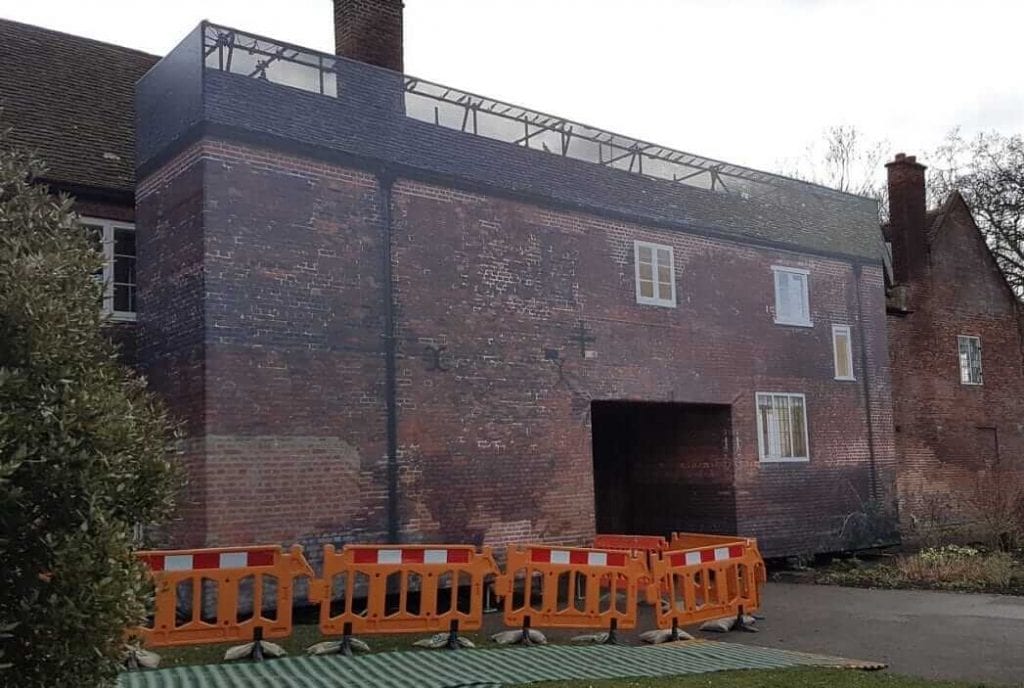
At Fulham Palace, the objective was to recreate the building’s distinctive brickwork, windows, and architectural features so that passers-by experienced minimal visual disruption.
The Importance of Getting the Design Right for Construction wrap
A successful construction wrap is not simply a large printed photograph. The illusion depends on careful attention to detail and technical precision.
Colour Matching
The historic brick tones and subtle variations in the façade required accurate colour reproduction. Even minor inconsistencies could break the illusion and make the wrap appear artificial.
Scale and Proportion
Architectural elements such as windows, cornices, and brick courses had to be reproduced at exact scale. Incorrect proportions would immediately draw attention to the fact that the façade was printed.
Perspective
Because the building is viewed primarily from ground level, the artwork had to account for natural viewing angles. Perspective adjustments ensure the printed façade appears correctly aligned when seen from typical pedestrian sight-lines.
Without this level of precision, the trompe l’oeil effect would be lost. Construction wrap is not just about printing big — it’s about printing intelligently.
Construction Wrap Is More Than Good Artwork
While design accuracy is essential, the structural preparation behind the scenes is often the most challenging part of the project.
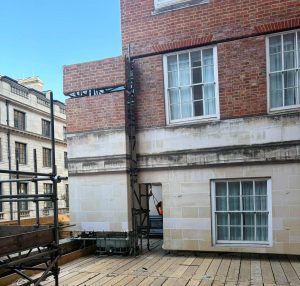
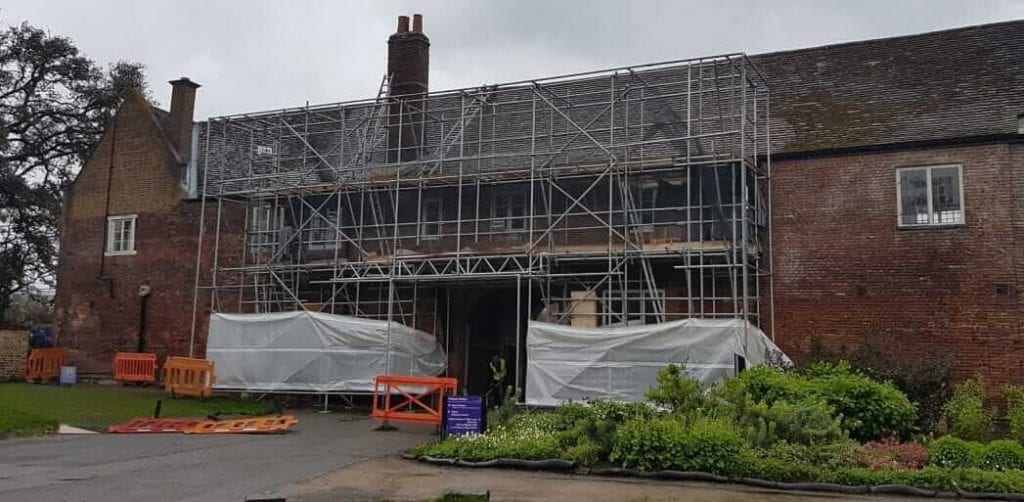
It is not possible to erect a standard scaffolding structure and simply hang a banner from it. The scaffold must be engineered specifically with the construction wrap in mind.
Designing the Scaffolding for a Building Wrap
For the Fulham Palace project, the scaffolding structure had to meet strict requirements:
- No projecting poles on the visible face
- Adequate structural support for wind loads
- A flat, uninterrupted surface for the wrap
- Secure fixing points for tensioning
Large printed materials can act like sails in windy conditions. Structural engineers must calculate wind loads carefully to ensure safety and stability.
This preparation stage is critical. Without a properly designed framework, even the best print and artwork cannot achieve a convincing result.
Installing the Sub-Frame for the Construction wrap
Once the main scaffold was erected, a dedicated sub-frame was installed. This sub-frame plays a vital role in achieving a seamless appearance.
Key considerations included:
- Using smooth couplings to prevent visible protrusions
- Allowing the printed material to wrap around scaffold poles
- Concealing fixing points
- Ensuring clean vertical and horizontal lines
The goal was to eliminate any visible structural distractions that could disrupt the illusion of a continuous façade.
Hanging and Tensioning the Construction Wrap
After preparation, the printed wrap was installed from the top down.
The process involved:
- Securing the wrap along the top line
- Aligning the artwork precisely with the scaffold structure
- Tensioning the material using specialist bungees
Tensioning removes folds and wrinkles while allowing the material to expand and contract with temperature changes. A smooth, taut finish is essential to preserve the trompe l’oeil effect.
At Fulham Palace, this careful installation ensured the printed façade appeared integrated and visually balanced within its historic surroundings.
Materials Used for the Fulham Palace Wrap
Material selection is always tailored to the site’s requirements. For heritage and high-profile projects, durability and visual clarity are paramount.
Common materials used in construction wrap projects include:
Mesh PVC
- Allows airflow to reduce wind resistance
- Suitable for exposed locations
- Durable and weather-resistant
Solid PVC
- Provides crisp image reproduction
- Ideal where maximum visual clarity is required
Specialist Fabric Systems
- Lightweight yet strong
- Capable of delivering detailed architectural imagery
The choice depends on factors such as wind exposure, building height, project duration, and desired finish.
Protecting Heritage While Work Continues
Restoration is essential for preserving historic landmarks, but the process can temporarily impact their appearance. A construction wrap helps balance practical site needs with heritage responsibility.
At Fulham Palace, the wrap:
- Concealed extensive scaffolding
- Preserved the visual dignity of the building
- Maintained a positive visitor experience
- Reduced disruption to the surrounding area
Rather than presenting an exposed construction site, the printed façade allowed the building to retain its character during renovation.
Why Professional Execution Matters
Construction wraps demand collaboration between designers, print specialists, structural engineers, and installation teams.
Key elements must align:
- Accurate site surveys
- Structural engineering calculations
- High-resolution print production
- Careful seam planning
- Precise installation
Any compromise in these areas can undermine the final result. When executed properly, however, the illusion appears natural and unobtrusive.
The Wider Benefits of Construction Wrap
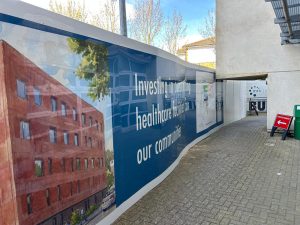
Beyond heritage sites, construction wraps offer advantages for:
- Urban refurbishment projects
- Commercial redevelopments
- High-profile residential schemes
- Public buildings under renovation
They help maintain visual standards, protect brand reputation, and improve public perception during works.
In busy London boroughs, presentation matters. A thoughtfully designed wrap demonstrates professionalism and respect for the surrounding community.
Project Print Management: Specialist Construction Wrap Solutions
Project Print Management provides end-to-end construction wrap services across London and the UK. From initial consultation and design development through to structural coordination and installation, we ensure every element is handled with care.
Our experience working on sensitive heritage sites such as Fulham Palace highlights our ability to balance aesthetics, engineering, and environmental demands.
We understand that construction wrap is not just about covering scaffolding. It is about preserving architectural presence, maintaining visual integrity, and delivering a high-quality finish that stands up to both scrutiny and the elements.
Transforming Temporary Structures into Seamless Façades
Scaffolding may be temporary, but its impact on a building’s appearance can be significant. A professionally designed and installed construction wrap transforms that temporary necessity into a visually cohesive solution.
The Fulham Palace project demonstrates how careful planning, expert design, and structural precision can successfully “deceive the eye” — allowing restoration to continue while the building’s character remains intact.
If you are planning a refurbishment or restoration project and want to maintain the integrity of your site’s appearance, Project Print Management can deliver a tailored construction wrap solution designed to perform both visually and structurally.
For more information on building wraps or a trompe l’oeil building wraps please look at our blog or contact us.